
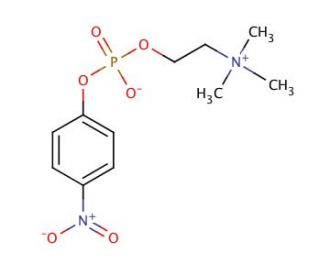

Molecular structure of O-(4-Nitrophenylphosphoryl)choline, CAS Number: 21064-69-7
O-(4-Nitrophenylphosphoryl)choline (CAS 21064-69-7)
Alternate Names:
NPCC; p-Nitrophenylphosphorylcholine
Application:
O-(4-Nitrophenylphosphoryl)choline is a reagent used in phospholipase C assays
CAS Number:
21064-69-7
Purity:
≥98%
Molecular Weight:
304.24
Molecular Formula:
C11H17N2O6P
For Research Use Only. Not Intended for Diagnostic or Therapeutic Use.
* Refer to Certificate of Analysis for lot specific data.
QUICK LINKS
Ordering Information
Description
Technical Information
Safety Information
SDS & Certificate of Analysis
O-(4-Nitrophenylphosphoryl)choline is a useful probe in the assay of Phospholipase C. O-(4-Nitrophenylphosphoryl)choline is a phosphorylcholine ester derived from p-nitrophenol, a encountered aromatic compound. Notably stable, this compound readily forms enduring complexes with diverse molecules, rendering it an excellent substrate for exploring enzyme-substrate interactions. Researchers have utilized O-(4-Nitrophenylphosphoryl)choline in the investigation of enzyme structure and function, including cholinesterases, proteases, and kinases. Additionally, it has been employed to probe the structure and function of proteins such as the nicotinic acetylcholine receptor.
O-(4-Nitrophenylphosphoryl)choline (CAS 21064-69-7) References
- A flavin cofactor-binding PAS domain regulates c-di-GMP synthesis in AxDGC2 from Acetobacter xylinum. | Qi, Y., et al. 2009. Biochemistry. 48: 10275-85. PMID: 19785462
- Activation of a PARACEST agent for MRI through selective outersphere interactions with phosphate diesters. | Huang, CH., et al. 2010. Inorg Chem. 49: 5963-70. PMID: 20509631
- High-level production of Bacillus cereus phospholipase C in Corynebacterium glutamicum. | Ravasi, P., et al. 2015. J Biotechnol. 216: 142-8. PMID: 26519562
- Molecularly imprinted polymer membranes and thin films for the separation and sensing of biomacromolecules. | Boysen, RI., et al. 2017. J Sep Sci. 40: 314-335. PMID: 27619154
- Structure of human nSMase2 reveals an interdomain allosteric activation mechanism for ceramide generation. | Airola, MV., et al. 2017. Proc Natl Acad Sci U S A. 114: E5549-E5558. PMID: 28652336
- Mechanism of Phospholipid Hydrolysis for Oyster Crassostrea plicatula Phospholipids During Storage Using Shotgun Lipidomics. | Chen, Q., et al. 2017. Lipids. 52: 1045-1058. PMID: 28975480
- Lipase and Phospholipase Activity Methods for Marine Organisms. | Nolasco-Soria, H., et al. 2018. Methods Mol Biol. 1835: 139-167. PMID: 30109650
- Biomimetic Polymer-Based Method for Selective Capture of C-Reactive Protein in Biological Fluids. | Wang, Q., et al. 2018. ACS Appl Mater Interfaces. 10: 41999-42008. PMID: 30412376
- Evaluation of Molecularly Imprinted Polymers for Point-of-Care Testing for Cardiovascular Disease. | Regan, B., et al. 2019. Sensors (Basel). 19: PMID: 31395843
- Sensing of C-Reactive Protein Using an Extended-Gate Field-Effect Transistor with a Tungsten Disulfide-Doped Peptide-Imprinted Conductive Polymer Coating. | Liu, KH., et al. 2022. Biosensors (Basel). 12: PMID: 35049659
Substrate of:
Enzyme.Ordering Information
| Product Name | Catalog # | UNIT | Price | Qty | FAVORITES | |
O-(4-Nitrophenylphosphoryl)choline, 100 mg | sc-215599 | 100 mg | $114.00 | |||
O-(4-Nitrophenylphosphoryl)choline, 250 mg | sc-215599A | 250 mg | $270.00 | |||
O-(4-Nitrophenylphosphoryl)choline, 500 mg | sc-215599B | 500 mg | $461.00 | |||
O-(4-Nitrophenylphosphoryl)choline, 1 g | sc-215599C | 1 g | $653.00 | |||
O-(4-Nitrophenylphosphoryl)choline, 5 g | sc-215599D | 5 g | $2195.00 | |||
O-(4-Nitrophenylphosphoryl)choline, 10 g | sc-215599E | 10 g | $4392.00 |