
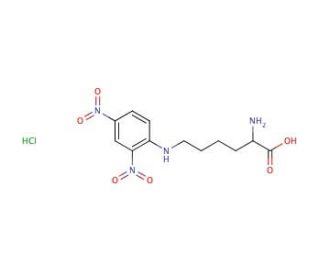

Nε-DNP-L-lysine hydrochloride (CAS 14401-10-6)
ENLACES RÁPIDOS
Nε-(2,4-Dinitrophenyl)-L-lysine hydrochloride, comúnmente conocido como DNPL, es un compuesto sintético ampliamente utilizado en la investigación científica por su notable capacidad para interactuar con proteínas y otras moléculas. Es una variante de lisina, un aminoácido esencial, y pertenece a la familia de compuestos 2,4-dinitrofenil. Su versatilidad ha llevado a su aplicación en una amplia gama de contextos de investigación. El papel prominente de DNPL en la investigación científica surge de su capacidad para unirse a proteínas y otras moléculas. Se utiliza ampliamente en diversos estudios bioquímicos, como investigaciones sobre interacciones proteína-proteína, cinética enzimática e interacciones receptor-ligando. Además, DNPL ha demostrado ser valioso en experimentos de laboratorio para cuantificar la afinidad de unión de proteínas y otras moléculas. El mecanismo de unión de DNPL implica la formación de un enlace covalente entre el grupo 2,4-dinitrofenil de DNPL y el grupo amino presente en la proteína o molécula. Es importante destacar que esta unión es reversible y puede ser interrumpida elevando el nivel de pH o introduciendo un agente reductor.
Nε-DNP-L-lysine hydrochloride (CAS 14401-10-6) Referencias
- Los resultados diferenciales de los mastocitos son sensibles a la cinética de unión FcεRI-Syk. | Schwartz, SL., et al. 2017. Mol Biol Cell. 28: 3397-3414. PMID: 28855374
- El inmunoensayo enzimático de transferencia de inmunocomplejos: Mecanismo de mejora de la sensibilidad en comparación con el enzimoinmunoanálisis sándwich convencional. | Watanabe, T. and Hashida, S. 2018. J Immunol Methods. 459: 76-80. PMID: 29883618
- Desarrollo de ensayos totalmente automatizados y ultrasensibles para la adiponectina urinaria y su aplicación como nuevos biomarcadores de la enfermedad renal diabética. | Watanabe, T., et al. 2020. Sci Rep. 10: 15869. PMID: 32985540
Información sobre pedidos
| Nombre del producto | Número de catálogo | UNIDAD | Precio | CANTIDAD | Favoritos | |
Nε-DNP-L-lysine hydrochloride, 100 mg | sc-228615 | 100 mg | $78.00 |