
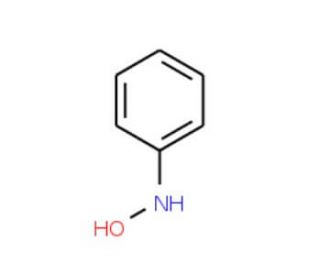

N-Phenylhydroxylamine の分子構造、CAS番号: 100-65-2
N-Phenylhydroxylamine (CAS 100-65-2)
別名:
N-Hydroxyaniline, N-Hydroxybenzenamine
アプリケーション:
N-Phenylhydroxylamineは有用な合成中間体です
CAS 番号:
100-65-2
純度:
≥95%
分子量:
109.13
分子式:
C6H7NO
補足情報:
これは輸送上の危険物に分類され、追加の送料が発生する場合があります。
試験・研究用以外には使用しないでください。 臨床及び体外診断には使用できません。
* Refer to Certificate of Analysis for lot specific data.
クイックリンク
注文情報
説明
技術サポート情報
安全情報
SDSと分析証明書
N‐フェニルヒドロキシルアミンは,有機合成の中間体としての役割のため,化学研究の様々な分野で関心のある化合物である。酸化還元反応の研究に用いられ、異なる条件下で還元剤または酸化剤として作用する。合成化学の文脈では、N-フェニルヒドロキシルアミンはアゾ染料の調製に用いられ、ジアゾ化を経て芳香族化合物とカップリングすることができる。さらに,それはニトロソ化合物の合成における試薬として働き,金属錯体形成および金属‐ニトロシル錯体の形成の研究に有用である。N‐フェニルヒドロキシルアミンの種々のラジカルとの反応性およびそのスカベンジング特性も研究の対象であり,特に高分子化学の分野では,分解に対する高分子の安定化に影響を及ぼす可能性がある。
N-Phenylhydroxylamine (CAS 100-65-2) 参考文献
- ジオキソルテニウム(VI)ポルフィリンとヒドロキシルアミンとの相互作用:N-置換ヒドロキシルアミンのルテニウムへの配位および一座ニトロソアレーン配位子を有するルテニウム錯体のX線結晶構造。 | Liang, JL., et al. 2001. Chemistry. 7: 2306-17. PMID: 11446633
- ヒドロキシルアミンの鉄(VI)酸化の動力学とメカニズム。 | Johnson, MD. and Hornstein, BJ. 2003. Inorg Chem. 42: 6923-8. PMID: 14552644
- シス-[RuIV(bpy)2(py)(O)]2+によるアニリンの段階的酸化。 | Seok, WK. and Meyer, TJ. 2004. Inorg Chem. 43: 5205-15. PMID: 15310196
- ニトロベンゼンの室温水素化触媒としての還元グラフェン酸化物。 | Gao, Y., et al. 2011. Chem Commun (Camb). 47: 2432-4. PMID: 21170437
- バンベルガー転位におけるアニリンジカチオン様転移状態。 | Yamabe, S., et al. 2013. Beilstein J Org Chem. 9: 1073-82. PMID: 23766821
- アニリン代謝産物N-フェニルヒドロキシルアミンおよびニトロソベンゼンによるヘモグロビンのチオール修飾のプロテオーム解析と構造変化の評価。 | Möller, C., et al. 2017. Sci Rep. 7: 14794. PMID: 29093547
- キュバン型Mo3S4クラスター水素化物によるニトロアレーン類の触媒的移動水素化:反応機構の本質を解明する。 | Safont, VS., et al. 2019. Phys Chem Chem Phys. 21: 17221-17231. PMID: 31346590
- 液体クロマトグラフィー/電気化学法によるin vitroで生成したアニリンおよび代謝物の定量。 | Radzik, DM. and Kissinger, PT. 1984. Anal Biochem. 140: 74-83. PMID: 6486418
- ヘミンを介したアニリンのパラヒドロキシル化:混合機能オキシダーゼの酸素活性化および挿入反応の潜在的モデル。 | Adams, PA. and Berman, MC. 1982. J Inorg Biochem. 17: 1-14. PMID: 7119772
- フェニルヒドロキシルアミン:アニリン関連脾臓酸化ストレスおよび心内膜下壊死誘導における役割。 | Khan, MF., et al. 1998. Toxicol Sci. 42: 64-71. PMID: 9538049
の阻害剤である:
DOHH (deoxyhypusine hydroxylase).注文情報
| 製品名 | カタログ # | 単位 | 価格 | 数量 | お気に入り | |
N-Phenylhydroxylamine, 1 g | sc-224149 | 1 g | $94.00 | |||
N-Phenylhydroxylamine, 5 g | sc-224149A | 5 g | $380.00 |