
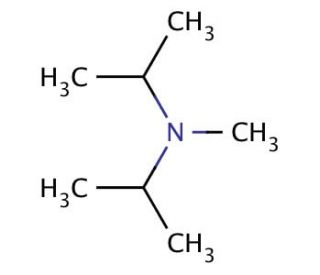

N,N-Diisopropylmethylamine (CAS 10342-97-9)
QUICK LINKS
N,N-Diisopropylmethylamine is a versatile organic compound utilized in various research and commercial applications. It is a colorless and volatile liquid with a mild and sweet odor. Derived from ammonia, it consists of two isopropyl groups and one methylamine group. N,N-Diisopropylmethylamine finds extensive applications in scientific research, serving as a key component in the synthesis of diverse compounds, including amines, alcohols, and amides. Its utility extends to the synthesis of pharmaceuticals, agrochemicals, polymers, and other organic substances. Furthermore, N,N-Diisopropylmethylamine plays a role in the production of perfumes, dyes, and other chemical compounds. Being a volatile compound, N,N-Diisopropylmethylamine can be easily absorbed through the skin and lungs. Upon absorption, it undergoes metabolism in the liver and is excreted in urine. As an aromatic amine, N,N-Diisopropylmethylamine exhibits interactions with various biological molecules such as proteins and enzymes. It is recognized for its ability to inhibit the activity of certain enzymes involved in the metabolism of other compounds, and it can also function as a substrate for specific enzymes.
N,N-Diisopropylmethylamine (CAS 10342-97-9) References
- Reacetylated chitosan microspheres for controlled delivery of anti-microbial agents to the gastric mucosa. | Portero, A., et al. 2002. J Microencapsul. 19: 797-809. PMID: 12569028
- Microwave-promoted selective mono-N-alkylation of anilines with tertiary amines by heterogeneous catalysis. | Lubinu, MC., et al. 2011. Chemistry. 17: 82-5. PMID: 21207602
- Dust as a collection media for contaminant source attribution. | Favela, KH., et al. 2012. Forensic Sci Int. 217: 39-49. PMID: 22018853
- A Highly Efficient Gold-Catalyzed Photoredox α-C(sp(3))-H Alkynylation of Tertiary Aliphatic Amines with Sunlight. | Xie, J., et al. 2015. Angew Chem Int Ed Engl. 54: 6046-50. PMID: 25823756
- Palladium(0)/NHC-Catalyzed Reductive Heck Reaction of Enones: A Detailed Mechanistic Study. | Raoufmoghaddam, S., et al. 2015. Chemistry. 21: 18811-20. PMID: 26561034
- Selective reduction of formamides to O-silylated hemiaminals or methylamines with HSiMe2Ph catalyzed by iridium complexes. | Guzmán, J., et al. 2019. Dalton Trans. 48: 4255-4262. PMID: 30847452
- Pd/C catalysis under microwave dielectric heating. | Cini, E., Petricci, E., & Taddei, M. (2017). Catalysts,. 7(3),: 89.
- A general photoinduced electron transfer-directed chemoselective perfluoroalkylation of N, N-dialkylhydrazones. | Xie, J., Li, J., Wurm, T., Weingand, V., Sung, H. L., Rominger, F.,.. & Hashmi, A. S. K. (2016). Organic Chemistry Frontiers,. 3(7),: 841-845.
- Palladium (II) acetate catalyzed reductive Heck reaction of enones;a practical approach. | Mannathan, S., Raoufmoghaddam, S., Reek, J. N., de Vries, J. G., & Minnaard, A. J. (2015). ChemCatChem,. 7(23),: 3923-3927.
- Metal-free synthesis of methylene-bridged bis-1, 3-dicarbonyl compounds via oxidative C–C bond cleavage of tertiary aliphatic amines. | Xing, L. J., Wang, X. M., Li, H. Y., Zhou, W., Kang, N., Wang, P., & Wang, B. (2014). RSC Advances,. 4(51),: 26783-26786.
- Development of an efficient Pd-catalyzed coupling process for axitinib. | Chekal, B. P., Guinness, S. M., Lillie, B. M., McLaughlin, R. W., Palmer, C. W., Post, R. J.,.. & Withbroe, G. J. (2014). Organic Process Research & Development,. 18(1),: 266-274.
- Reactions of Trialkylamines with the Cyclocarbaphosphazene Cl2PN (ClCN) 2: Selectivity in the Cleavage of Alkyl Groups. | Elias, A. J., Mishra, P. K., Kumar, M. S., Behera, N., & Reddy, N. D. (). 2005. Phosphorus, Sulfur, and Silicon and the Related Elements,. 180(8),: 1785-1794.
- Stable and Reusable Palladium Nanoparticles‐Catalyzed Conjugate Addition of Aryl Iodides to Enones: Route to Reductive Heck Products. | Parveen, N., Saha, R., & Sekar, G. (). 2017. Advanced Synthesis & Catalysis,. 359(21),.: 3741-3751.
Ordering Information
| Product Name | Catalog # | UNIT | Price | Qty | FAVORITES | |
N,N-Diisopropylmethylamine, 10 ml | sc-228761 | 10 ml | $100.00 |