
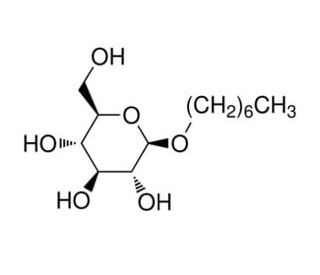

n-Heptyl-β-D-glucopyranoside (CAS 78617-12-6)
QUICK LINKS
n-Heptyl-β-D-glucopyranoside, a non-ionic surfactant derived from glucose, serves as a crucial tool in various research endeavors, primarily in biochemistry and biotechnology. Its mechanism of action revolves around its amphiphilic nature, allowing it to solubilize and stabilize membrane proteins. This property makes it invaluable in the isolation and purification of membrane-bound proteins for structural and functional studies. Moreover, n-heptyl-β-D-glucopyranoside has been extensively utilized in the formation of lipid bilayers and micelles, essential components in mimicking biological membranes for biophysical investigations. Its compatibility with biological systems and low cytotoxicity further enhance its utility in cell culture experiments and biophysical assays. Additionally, this chemical has found applications in various research areas, including membrane protein biochemistry, structural biology, drug delivery, and biomimetic membrane systems. Ongoing research continues to explore novel uses and modifications of n-heptyl-β-D-glucopyranoside, highlighting its significance in advancing our understanding of membrane biology and facilitating the development of new biotechnological tools.
n-Heptyl-β-D-glucopyranoside (CAS 78617-12-6) References
- Determination and application of empirically derived detergent phase boundaries to effectively crystallize membrane proteins. | Koszelak-Rosenblum, M., et al. 2009. Protein Sci. 18: 1828-39. PMID: 19554626
- Helical extension of the neuronal SNARE complex into the membrane. | Stein, A., et al. 2009. Nature. 460: 525-8. PMID: 19571812
- Lipid and peptide dynamics in membranes upon insertion of n-alkyl-beta-D-glucopyranosides. | Meier, M. and Seelig, J. 2010. Biophys J. 98: 1529-38. PMID: 20409472
- Current trends in α-helical membrane protein crystallization: an update. | Parker, JL. and Newstead, S. 2012. Protein Sci. 21: 1358-65. PMID: 22811290
- Liposome reconstitution and modulation of recombinant prenylated human Rac1 by GEFs, GDI1 and Pak1. | Zhang, SC., et al. 2014. PLoS One. 9: e102425. PMID: 25014207
- Low cost, microcontroller based heating device for multi-wavelength differential scanning fluorimetry. | Hoeser, J., et al. 2018. Sci Rep. 8: 1457. PMID: 29362420
- Direct Activation of Human MLKL by a Select Repertoire of Inositol Phosphate Metabolites. | McNamara, DE., et al. 2019. Cell Chem Biol. 26: 863-877.e7. PMID: 31031142
- Identification of new glycosidic terpenols and norisoprenoids (aroma precursors) in C. arabica L. green coffee by using a high-resolution mass spectrometry database developed in grape metabolomics. | De Rosso, M., et al. 2022. Curr Res Food Sci. 5: 336-344. PMID: 35198992
- Genetic architecture of berry aroma compounds in a QTL (quantitative trait loci) mapping population of interspecific hybrid grapes (Vitis labruscana × Vitis vinifera). | Koyama, K., et al. 2022. BMC Plant Biol. 22: 458. PMID: 36151514
- Determination and Kinetic Characterization of a New Potential Inhibitor for AmsI Protein Tyrosine Phosphatase from the Apple Pathogen Erwinia amylovora. | Albani, S., et al. 2023. Molecules. 28: PMID: 38067503
Ordering Information
| Product Name | Catalog # | UNIT | Price | Qty | FAVORITES | |
n-Heptyl-β-D-glucopyranoside, 500 mg | sc-281075 | 500 mg | $196.00 |