
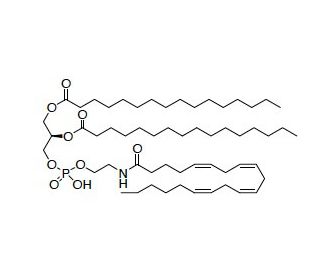

N-Arachidonoyl phosphatidylethanolamine
See product citations (3)
QUICK LINKS
N-Arachidonoyl phosphatidylethanolamine (NAPE) is a biologically significant molecule predominantly found in the neural tissue and plays a role in the biosynthesis of N-acylethanolamines (NAEs), including anandamide, which are involved in various signaling pathways. N-Arachidonoyl phosphatidylethanolamine′s mechanism of action revolves around its function as a precursor molecule. It undergoes enzymatic hydrolysis by specific phospholipase D enzymes, which catalyze the conversion of N-Arachidonoyl phosphatidylethanolamine to NAEs. This process is essential for the generation of bioactive molecules that participate in intracellular signaling and regulate a variety of physiological processes. In research, N-Arachidonoyl phosphatidylethanolamine is frequently studied to understand its role in the modulation of these signaling pathways and to elucidate its potential impact on cellular functions. Its involvement in the synthesis of critical signaling molecules makes it a molecule of interest in studies related to cellular communication and mechanism studies in biochemistry and neurobiology.
N-Arachidonoyl phosphatidylethanolamine References
- Analysis of cannabinoid receptor binding and mRNA expression and endogenous cannabinoid contents in the developing rat brain during late gestation and early postnatal period. | Berrendero, F., et al. 1999. Synapse. 33: 181-91. PMID: 10420166
- Biosynthesis and degradation of anandamide and 2-arachidonoylglycerol and their possible physiological significance. | Sugiura, T., et al. 2002. Prostaglandins Leukot Essent Fatty Acids. 66: 173-92. PMID: 12052034
- Radiochromatographic assay of N-acyl-phosphatidylethanolamine-specific phospholipase D activity. | Fezza, F., et al. 2005. Anal Biochem. 339: 113-20. PMID: 15766717
- A biosynthetic pathway for anandamide. | Liu, J., et al. 2006. Proc Natl Acad Sci U S A. 103: 13345-50. PMID: 16938887
- Multiple pathways involved in the biosynthesis of anandamide. | Liu, J., et al. 2008. Neuropharmacology. 54: 1-7. PMID: 17631919
- Identification of biosynthetic precursors for the endocannabinoid anandamide in the rat brain. | Astarita, G., et al. 2008. J Lipid Res. 49: 48-57. PMID: 17957091
- Endocannabinoid signaling and its regulation by nutrients. | Bisogno, T. and Maccarrone, M. 2014. Biofactors. 40: 373-80. PMID: 24753395
- Characterization of N-acyl phosphatidylethanolamine-specific phospholipase-D isoforms in the nematode Caenorhabditis elegans. | Harrison, N., et al. 2014. PLoS One. 9: e113007. PMID: 25423491
- Homeostatic regulation of brain functions by endocannabinoid signaling. | Chen, C. 2015. Neural Regen Res. 10: 691-2. PMID: 26109933
- Evidence for a GPR18 Role in Diurnal Regulation of Intraocular Pressure. | Miller, S., et al. 2016. Invest Ophthalmol Vis Sci. 57: 6419-6426. PMID: 27893106
- Synthetic cannabinoids and their impact on neurodevelopmental processes. | Alexandre, J., et al. 2020. Addict Biol. 25: e12824. PMID: 31441196
- Formation and inactivation of endogenous cannabinoid anandamide in central neurons. | Di Marzo, V., et al. 1994. Nature. 372: 686-91. PMID: 7990962
- Potential biosynthetic connections between the two cannabimimetic eicosanoids, anandamide and 2-arachidonoyl-glycerol, in mouse neuroblastoma cells. | Di Marzo, V., et al. 1996. Biochem Biophys Res Commun. 227: 281-8. PMID: 8858137
Ordering Information
| Product Name | Catalog # | UNIT | Price | Qty | FAVORITES | |
N-Arachidonoyl phosphatidylethanolamine, 2.5 mg | sc-221989 | 2.5 mg | $214.00 |