
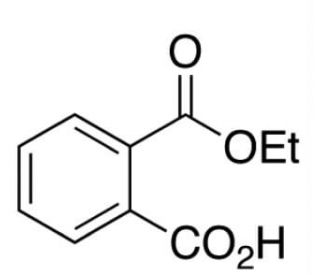

Monoethyl Phthalate 的分子结构
Monoethyl Phthalate (CAS 2306-33-4)
备用名:
Ethyl 2-Carboxybenzoate; Phthalic Acid Monoethyl Ester; 1,2-Benzenedicarboxylic Acid Monoethyl Ester
CAS号码:
2306-33-4
分子量:
194.18
分子式:
C10H10O4
For Research Use Only. Not Intended for Diagnostic or Therapeutic Use.
* Refer to Certificate of Analysis for lot specific data.
快捷链接
订购信息
描述
技术信息
安全信息
安全技术说明书和分析证明书
Monoethyl Phthalate(MEP)是邻苯二甲酸的单酯,由邻苯二甲酸的羧基之一与乙醇缩合而成。它是苯甲酸的衍生物,也是邻苯二甲酸二乙酯(DEP)的代谢产物之一。它已在多种生物流体中被检测到,如尿液和唾液;因此,它可以用作DEP暴露的生物标志物。像Monoethyl Phthalate这样的邻苯二甲酸酯通常用作各种工业应用中的增塑剂。邻苯二甲酸盐,包括DEP及其代谢物如Monoethyl Phthalate,已被研究作为内分泌干扰化学物质的潜力,它们可能干扰激素系统。
Monoethyl Phthalate (CAS 2306-33-4) 参考文献
- 低剂量邻苯二甲酸单乙酯(MEP)暴露通过激活 1.1B4 人胰腺β细胞的 PDX-1 引发细胞增殖。 | Güven, C., et al. 2016. Food Chem Toxicol. 93: 41-50. PMID: 27133914
- 邻苯二甲酸酯代谢物, 消费习惯和健康影响。 | Wallner, P., et al. 2016. Int J Environ Res Public Health. 13: PMID: 27428989
- 个人护理产品中的邻苯二甲酸盐, 苯甲酸酯和苯酚与女孩和男孩青春期发育时间的关系。 | Harley, KG., et al. 2019. Hum Reprod. 34: 109-117. PMID: 30517665
- 利用超高效液相色谱-串联质谱法同时测定一项毒物动力学研究中采集的大鼠血浆, 尿液和各种组织中的邻苯二甲酸二乙酯及其主要代谢物邻苯二甲酸单乙酯。 | Jeong, SH., et al. 2019. J Pharm Biomed Anal. 173: 108-119. PMID: 31125947
- 邻苯二甲酸盐代谢物与子宫内膜异位症风险之间的关系:一项 Meta 分析。 | Cai, W., et al. 2019. Int J Environ Res Public Health. 16: PMID: 31574938
- 钯催化羧酸盐辅助芳香族酸乙氧基羧化,与二氟溴乙酸乙酯合成邻苯二甲酸单乙酯衍生物。 | Tao, N., et al. 2019. Org Lett. 21: 8607-8610. PMID: 31621337
- 采用气相色谱法测定邻苯二甲酸酯代谢物的新进展:省去了衍生化步骤。 | Tankiewicz, M., et al. 2019. Front Chem. 7: 928. PMID: 32010672
- 挪威沿海水域港湾鼠海豚(Phocoena phocoena)体内的邻苯二甲酸酯代谢物。 | Rian, MB., et al. 2020. Environ Int. 137: 105525. PMID: 32028175
- 利用基于生理的邻苯二甲酸二乙酯及其主要代谢物邻苯二甲酸单乙酯的药代动力学模型,对人类进行风险评估。 | Jeong, SH., et al. 2020. Arch Toxicol. 94: 2377-2400. PMID: 32303804
- 产前接触邻苯二甲酸盐与低风险儿童的自闭症谱系障碍症状。 | Haggerty, DK., et al. 2021. Neurotoxicol Teratol. 83: 106947. PMID: 33412243
- 美国佛罗里达州萨拉索塔湾普通瓶鼻海豚(Tursiops truncatus)体内邻苯二甲酸单(2-乙基己基)酯(MEHP)和邻苯二甲酸单乙酯(MEP)浓度的人口学评估。 | Dziobak, MK., et al. 2021. Geohealth. 5: e2020GH000348. PMID: 34036207
- 生命早期接触邻苯二甲酸盐是否会影响儿童认知能力的种族差异? | Patti, MA., et al. 2022. Environ Epidemiol. 6: e205. PMID: 35434463
- 绝经前和围绝经期妇女尿液中邻苯二甲酸盐生物标志物浓度的决定因素,并考虑种族因素。 | Ryva, BA., et al. 2022. Environ Res. 214: 114056. PMID: 35952743
订购信息
| 产品名称 | 产品编号 | 规格 | 价格 | 数量 | 收藏夹 | |
Monoethyl Phthalate, 100 mg | sc-505736 | 100 mg | $350.00 |