
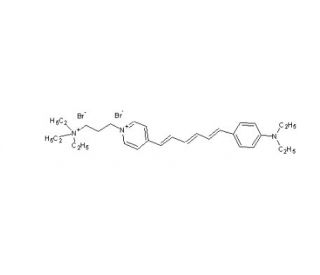

MM 4-64 (CAS 162112-35-8)
See product citations (4)
QUICK LINKS
MM 4-64, also known as N-(3-Triethylammoniopropyl)-4-(6-(4-(diethylamino)phenyl) hexatrienyl)pyridinium dibromide, known for its striking fluorescent properties, is highly valued in the realm of neurobiological research. This chemical functions primarily as a fluorescent dye, proving essential for the detailed visualization of synaptic activity at neuromuscular junctions. The compound exhibits a unique ability to bind selectively to specific sites within the synaptic cleft, allowing researchers to observe and analyze the dynamic processes governing neurotransmitter release and synaptic transmission in real time. The bright fluorescence emitted by this compound under specific wavelengths makes it an indispensable tool in the study of neuromuscular communication, providing critical insights into the fundamental mechanisms of nerve-muscle synaptic interaction and aiding in the exploration of synaptic plasticity and function. Through its application, researchers can illuminate the intricate events at neuromuscular junctions, facilitating advancements in our understanding of neural connectivity and the basic science underlying nerve-to-muscle signaling.
MM 4-64 (CAS 162112-35-8) References
- Calpain-dependent cleavage of junctophilin-2 and T-tubule remodeling in a mouse model of reversible heart failure. | Wu, CY., et al. 2014. J Am Heart Assoc. 3: e000527. PMID: 24958777
- Overexpression of junctophilin-2 does not enhance baseline function but attenuates heart failure development after cardiac stress. | Guo, A., et al. 2014. Proc Natl Acad Sci U S A. 111: 12240-5. PMID: 25092313
- In situ single photon confocal imaging of cardiomyocyte T-tubule system from Langendorff-perfused hearts. | Chen, B., et al. 2015. Front Physiol. 6: 134. PMID: 25999861
- Cholesterol is required for maintaining T-tubule integrity and intercellular connections at intercalated discs in cardiomyocytes. | Zhu, Y., et al. 2016. J Mol Cell Cardiol. 97: 204-12. PMID: 27255730
- Immobilisation of barley aleurone layers enables parallelisation of assays and analysis of transient gene expression in single cells. | Zór, K., et al. 2017. Plant Physiol Biochem. 118: 71-76. PMID: 28622601
- Destructive Role of TMAO in T-Tubule and Excitation-Contraction Coupling in the Adult Cardiomyocytes. | Jin, B., et al. 2020. Int Heart J. 61: 355-363. PMID: 32173700
- Peroxisomes Implicated in the Biosynthesis of Siderophores and Biotin, Cell Wall Integrity, Autophagy, and Response to Hydrogen Peroxide in the Citrus Pathogenic Fungus Alternaria alternata. | Wu, PC., et al. 2021. Front Microbiol. 12: 645792. PMID: 34262533
- Identification and Analysis of GhEXO Gene Family Indicated That GhEXO7_At Promotes Plant Growth and Development Through Brassinosteroid Signaling in Cotton (Gossypium hirsutum L.). | Li, S., et al. 2021. Front Plant Sci. 12: 719889. PMID: 34603349
- CMYA5 establishes cardiac dyad architecture and positioning. | Lu, F., et al. 2022. Nat Commun. 13: 2185. PMID: 35449169
- Pexophagy is critical for fungal development, stress response, and virulence in Alternaria alternata. | Wu, PC., et al. 2022. Mol Plant Pathol. 23: 1538-1554. PMID: 35810316
Ordering Information
| Product Name | Catalog # | UNIT | Price | Qty | FAVORITES | |
MM 4-64, 1 mg | sc-477259 | 1 mg | $255.00 |