
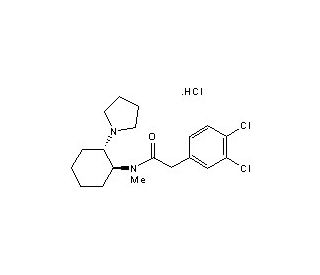

(−)-U-50488 hydrochloride (CAS 67198-19-0)
LINKS RÁPIDOS
O cloridrato de (-)-U-50488 é um composto que funciona como um agonista seletivo do recetor κ-opióide. Actua ligando-se e activando o recetor κ-opióide, conduzindo a uma cascata de eventos de sinalização intracelular. Esta ativação resulta, em última análise, na modulação da libertação de neurotransmissores, nomeadamente de dopamina, e na inibição da excitabilidade neuronal. A nível molecular, o cloridrato de (-)-U-50488 interage com o recetor κ-opióide, provocando alterações conformacionais e o início de vias de sinalização a jusante. O mecanismo de ação do cloridrato de (-)-U-50488 envolve a regulação da transmissão sináptica e da atividade neuronal, o que pode ter implicações no estudo do papel dos receptores κ-opióides em vários processos fisiológicos e patológicos.
(−)-U-50488 hydrochloride (CAS 67198-19-0) Referencias
- Estudo dos mecanismos de ação do U-50,488 na prevenção do desenvolvimento de tolerância à morfina em cobaias. | Tao, PL., et al. 2000. Chin J Physiol. 43: 179-84. PMID: 11292183
- A ativação exógena dos receptores opióides delta e kappa proporciona cardioprotecção no coração isolado de murino. | Peart, JN. and Gross, GJ. 2004. Basic Res Cardiol. 99: 29-37. PMID: 14685703
- Inibição do cloridrato de (-)-propranolol pelo seu enantiómero em ratos brancos - um estudo aleatório controlado por placebo. | Kuzeff, RM., et al. 2004. Forsch Komplementarmed Klass Naturheilkd. 11: 14-9. PMID: 15004443
- Ativação da proteína G e modulação do AMP cíclico pela naloxona benzoil-hidrazona em camadas distintas do bolbo olfativo do rato. | Onali, P. and Olianas, MC. 2004. Br J Pharmacol. 143: 638-48. PMID: 15451772
- Atividade agonista da naloxona benzoil-hidrazona em receptores opióides recombinantes e nativos. | Olianas, MC., et al. 2006. Br J Pharmacol. 147: 360-70. PMID: 16402046
- Papel da função do recetor delta-opióide na neurogénese e neuroprotecção. | Narita, M., et al. 2006. J Neurochem. 97: 1494-505. PMID: 16696856
- O efeito cronotrópico da D-Ala2,Leu5,Arg6-encefalina (dalargina) está associado à ativação de receptores kappa-opióides periféricos. | Maslov, LN., et al. 2005. Bull Exp Biol Med. 140: 682-6. PMID: 16848223
- Efeitos inibitórios e excitatórios da ativação dos receptores micro-, delta- e kappa-opióides na respiração de tartarugas Trachemys scripta acordadas. | Johnson, SM., et al. 2008. Am J Physiol Regul Integr Comp Physiol. 295: R1599-612. PMID: 18784338
- Reação da cauda de Straub em ratos tratados com um antagonista dos receptores σ(1) em combinação com metanfetamina. | Kitanaka, J., et al. 2012. Brain Res. 1482: 40-6. PMID: 22981417
- A sensibilização periférica aumenta a expressão e ativação do recetor opióide pela crotalfina em ratos. | Zambelli, VO., et al. 2014. PLoS One. 9: e90576. PMID: 24594607
- A ocitocina é um modulador alostérico positivo dos receptores κ-opióides, mas não dos receptores Δ-opióides na via de sinalização da proteína G. | Miyano, K., et al. 2021. Cells. 10: PMID: 34685631
- O U-50,488 bloqueia o desenvolvimento da tolerância e da dependência da morfina numa dose muito baixa em cobaias. | Tao, PL., et al. 1994. Eur J Pharmacol. 256: 281-6. PMID: 8045272
- Os opiáceos suprimem as correntes pós-sinápticas inibitórias espontâneas e induzidas por NMDA no núcleo dorsal da rafe do rato in vitro. | Jolas, T. and Aghajanian, GK. 1997. Brain Res. 755: 229-45. PMID: 9175891
Informacoes sobre ordens
| Nome do Produto | Numero de Catalogo | UNID | Preco | Qde | FAVORITOS | |
(−)-U-50488 hydrochloride, 5 mg | sc-203714 | 5 mg | $155.00 | |||
(−)-U-50488 hydrochloride, 25 mg | sc-203714A | 25 mg | $510.00 |