
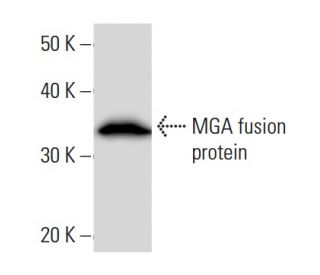

MGA Antibody (MGA6A4H5): sc-81105
- MGA Antibody (MGA6A4H5) is a mouse monoclonal IgG1 MGA antibody, cited in 1 publications, provided at 100 µg/ml
- raised against a recombinant protein corresponding to a region near the C-terminus of MGA of human origin
- recommended for detection of MGA of human origin by WB and IP
- At present, we have not yet completed the identification of the preferred secondary detection reagent(s) for MGA Antibody (MGA6A4H5). This work is in progress.

QUICK LINKS
SEE ALSO...
MGA Antibody (MGA6A4H5) is a mouse monoclonal IgG1 antibody that detects MGA protein of human origin by western blotting (WB) and immunoprecipitation (IP). Anti-MGA antibody (MGA6A4H5) is available as a non-conjugated format, providing researchers with a reliable tool for studying this important protein. MGA protein, also known as MAX gene associated or MAD5, plays a crucial role in regulating cell proliferation and differentiation through interactions with other transcription factors. Specifically, MGA is a member of the Mad family and can form heterodimers with proteins such as Max, which is essential for Myc function. These dimers bind to the E-box sequence CACGTG, influencing critical cellular processes like growth, proliferation, and apoptosis. Notably, MGA possesses a unique Myc-like basic helix-loop-helix (bHLH) motif and a T-box DNA-binding domain, allowing MGA to regulate transcription of both MAX-network and T-box target genes. This dual functionality enables MGA to act as both a transcriptional repressor and activator, highlighting MGA′s significance in cellular signaling pathways. Furthermore, MGA is widely expressed and is considered a potential antagonist of Myc oncoproteins, making MGA a valuable target for research in cancer biology and therapeutic development.
Alexa Fluor® is a trademark of Molecular Probes Inc., OR., USA
LI-COR® and Odyssey® are registered trademarks of LI-COR Biosciences
MGA Antibody (MGA6A4H5) References:
- Mga, a dual-specificity transcription factor that interacts with Max and contains a T-domain DNA-binding motif. | Hurlin, PJ., et al. 1999. EMBO J. 18: 7019-28. PMID: 10601024
- The Myc/Max/Mad network and the transcriptional control of cell behavior. | Grandori, C., et al. 2000. Annu Rev Cell Dev Biol. 16: 653-99. PMID: 11031250
- The conserved Mynd domain of BS69 binds cellular and oncoviral proteins through a common PXLXP motif. | Ansieau, S. and Leutz, A. 2002. J Biol Chem. 277: 4906-10. PMID: 11733528
- A complex with chromatin modifiers that occupies E2F- and Myc-responsive genes in G0 cells. | Ogawa, H., et al. 2002. Science. 296: 1132-6. PMID: 12004135
- The evolutionary relationships of zebrafish genes tbx6, tbx16/spadetail and mga. | Lardelli, M. 2003. Dev Genes Evol. 213: 519-22. PMID: 12908107
- The Mad side of the Max network: antagonizing the function of Myc and more. | Rottmann, S. and Lüscher, B. 2006. Curr Top Microbiol Immunol. 302: 63-122. PMID: 16620026
- The MAX-interacting transcription factor network. | Hurlin, PJ. and Huang, J. 2006. Semin Cancer Biol. 16: 265-74. PMID: 16908182
- Mga safeguards embryonic stem cells from acquiring extraembryonic endoderm fates. | Qin, J., et al. 2021. Sci Adv. 7: PMID: 33523934
- Sarcoma with MGA::NUTM1 fusion: a report of three cases and literature review. | Wangsiricharoen, S., et al. 2023. Histopathology. 83: 712-721. PMID: 37442637
- MGA deletion leads to Richter's transformation by modulating mitochondrial OXPHOS. | Iyer, P., et al. 2024. Sci Transl Med. 16: eadg7915. PMID: 39083585
- MGA loss-of-function variants cause premature ovarian insufficiency. | Tang, S., et al. 2024. J Clin Invest. 134: PMID: 39545409
- MGA-related syndrome: A proposed novel disorder. | McGivern, B., et al. 2025. HGG Adv. 6: 100387. PMID: 39600096
Ordering Information
| Product Name | Catalog # | UNIT | Price | Qty | FAVORITES | |
MGA Antibody (MGA6A4H5) | sc-81105 | 100 µg/ml | $339.00 |