
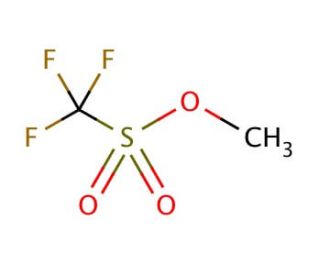

Methyl trifluoromethanesulfonate (CAS 333-27-7)
ENLACES RÁPIDOS
El trifluorometanosulfonato de metilo actúa como agente alquilante en reacciones químicas. Actúa transfiriendo su grupo metilo a sitios nucleófilos de las moléculas, lo que conduce a la formación de enlaces covalentes. El mecanismo de acción del trifluorometanosulfonato de metilo implica la alquilación de grupos funcionales nucleófilos, como los grupos hidroxilo, amino y tiol. Este proceso de alquilación puede dar lugar a la modificación de biomoléculas, como proteínas y ácidos nucleicos, afectando a su estructura y función. La capacidad del trifluorometanosulfonato de metilo para alquilarse en sitios nucleófilos puede ser útil en la síntesis química y la modificación de biomoléculas. Su mecanismo de acción a nivel molecular permite la manipulación de grupos funcionales específicos, posibilitando el estudio de las relaciones estructura-actividad y el desarrollo de nuevos compuestos con las propiedades deseadas.
Methyl trifluoromethanesulfonate (CAS 333-27-7) Referencias
- Síntesis estereoselectiva de 2-S-fenil-2-deoxi-beta-glicósidos usando donantes fenil 2,3-O-tionocarbonil-1-tioglicósidos vía 1,2-migración y glicosidación concurrente. | Yu, B. and Yang, Z. 2001. Org Lett. 3: 377-9. PMID: 11428018
- Método para la determinación de la distribución de polisulfuro inorgánico en sistemas acuáticos. | Kamyshny, A., et al. 2006. Anal Chem. 78: 2631-9. PMID: 16615773
- Síntesis y caracterización de complejos de trispirazolilborato de osmio(II). | Dickinson, PW. and Girolami, GS. 2006. Inorg Chem. 45: 5215-24. PMID: 16780347
- Síntesis de polifosfacumulenos extendidos. | Martin, D., et al. 2006. Chemistry. 12: 8444-50. PMID: 17009365
- Preparación de iones de aziridinio estables y sus aperturas anulares. | Kim, Y., et al. 2008. Chem Commun (Camb). 4363-5. PMID: 18802571
- [Tres casos de intoxicación ocupacional por trifluorometanosulfonato de metilo]. | Zhang, XT., et al. 2010. Zhonghua Lao Dong Wei Sheng Zhi Ye Bing Za Zhi. 28: 304. PMID: 20465966
- Derivatización de esteroides con dansilhidrazina utilizando ácido trifluorometanosulfónico como catalizador. | Appelblad, P., et al. 1997. Anal Chem. 69: 4905-11. PMID: 21639160
- Fosforaniminas catiónicas cristalinas, libres de bases de Lewis (sales de iminofosfonio). | Dielmann, F., et al. 2013. J Am Chem Soc. 135: 14071-3. PMID: 24007472
- Formación de enlaces boro-elemento del grupo principal mediante reacciones con un organoborón tricoordinado L2PhB: (L = oxazol-2-ilideno). | Kong, L., et al. 2017. Inorg Chem. 56: 5586-5593. PMID: 28134518
- Oxidación remota y tardía de enlaces C-H alifáticos en moléculas que contienen amida. | Nanjo, T., et al. 2017. J Am Chem Soc. 139: 14586-14591. PMID: 28921954
- Síntesis de β-manósidos mediante glucósidos preordenados. | Ziegler, T. and Lemanski, G. 1998. Angew Chem Int Ed Engl. 37: 3129-3132. PMID: 29711320
- Síntesis One-Pot Inducida por Fluorina Aromática de Colorante de Cianina Trimetina Perfluorado en Anillo y sus Notables Propiedades de Fluorescencia. | Funabiki, K., et al. 2019. J Org Chem. 84: 4372-4380. PMID: 30887808
- Preparación de triflatos de diaril sulfoxinio y su aplicación en reacciones de acoplamiento cruzado catalizadas por paladio. | Wang, C., et al. 2022. Chem Asian J. 17: e202200828. PMID: 35947778
Información sobre pedidos
| Nombre del producto | Número de catálogo | UNIDAD | Precio | CANTIDAD | Favoritos | |
Methyl trifluoromethanesulfonate, 10 g | sc-253036 | 10 g | $67.00 |