
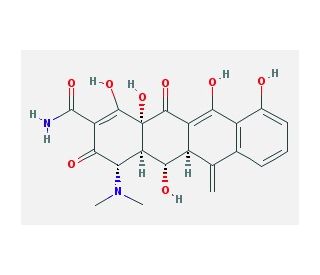

Methacycline (CAS 914-00-1)
ACCÈS RAPIDE AUX LIENS
La méthacycline est un dérivé de l'antibiotique tétracycline largement utilisé dans la recherche pour étudier les mécanismes de résistance bactérienne et l'efficacité des régimes antibiotiques. Antibiotique à large spectre, la méthacycline agit principalement en inhibant la synthèse des protéines chez les bactéries, mécanisme qu'elle réalise en se liant à la sous-unité ribosomale 30S. Cette liaison perturbe la fixation de l'aminoacyl-ARNt au complexe ARN-ribosome, inhibant ainsi l'ajout de nouveaux acides aminés à la chaîne peptidique en croissance et stoppant efficacement la croissance bactérienne. Dans les études scientifiques, la méthacycline est particulièrement utile pour étudier le développement et la transmission de la résistance aux antibiotiques. Les chercheurs utilisent ce composé pour étudier comment les bactéries deviennent résistantes aux tétracyclines, ce qui implique des mutations dans les protéines ribosomales ou des changements dans la perméabilité des cellules bactériennes au médicament. En outre, la méthacycline est utilisée en microbiologie environnementale pour étudier l'impact de la contamination par les antibiotiques sur les communautés microbiennes. Son rôle dans l'influence de la dynamique microbienne dans divers écosystèmes aide à élucider les impacts écologiques plus larges de l'utilisation des antibiotiques et de la résistance. En comprenant ces mécanismes, les chercheurs peuvent contribuer au développement de stratégies plus efficaces pour gérer la résistance aux antibiotiques dans les contextes cliniques et environnementaux, fournissant ainsi des informations cruciales pour l'utilisation durable des antibiotiques.
Methacycline (CAS 914-00-1) Références
- Pharmacocinétique et pharmacodynamie des tétracyclines, y compris les glycylcyclines. | Agwuh, KN. and MacGowan, A. 2006. J Antimicrob Chemother. 58: 256-65. PMID: 16816396
- Tétracyclines et inflammation pulmonaire. | Rempe, S., et al. 2007. Endocr Metab Immune Disord Drug Targets. 7: 232-6. PMID: 18220943
- Suppléments en fer: une cause fréquente d'interactions médicamenteuses. | Campbell, NR. and Hasinoff, BB. 1991. Br J Clin Pharmacol. 31: 251-5. PMID: 2054263
- Liaison de la méthacycline à l'albumine sérique humaine au niveau du sous-domaine IIA à l'aide de méthodes multispectroscopiques et de modélisation moléculaire. | Dong, C., et al. 2013. Luminescence. 28: 933-41. PMID: 23233363
- Inhibition de la transition épithéliale-mésenchymateuse et de la fibrose pulmonaire par la méthacycline. | Xi, Y., et al. 2014. Am J Respir Cell Mol Biol. 50: 51-60. PMID: 23944988
- La méthacycline s'avère très efficace pour réduire la toxicité dans un modèle SCA3 de Caenorhabditis elegans. | Amigoni, L., et al. 2019. Biochim Biophys Acta Gen Subj. 1863: 279-290. PMID: 30420336
- Activité de la méthacycline, des tétracyclines apparentées et d'autres antibiotiques contre diverses formes L et leurs bactéries mères in vitro. | Hubert, EG., et al. 1972. Antimicrob Agents Chemother. 2: 276-80. PMID: 4670500
- Comparaison de la déméthylchlortétracycline, de la lymécycline et de la méthacycline chez des patients souffrant d'exacerbations purulentes de la bronchite. | Pines, A., et al. 1968. Br J Dis Chest. 62: 19-26. PMID: 4968585
- Méthacycline et déméclocycline en relation avec la lumière du soleil. | Frost, P., et al. 1971. JAMA. 216: 326-9. PMID: 5107921
- La méthacycline comparée à l'ampicilline dans les exacerbations bactériennes aiguës de la bronchite chronique. Une étude croisée en double aveugle. | Chodosh, S., et al. 1976. Chest. 69: 587-92. PMID: 773601
Informations pour la commande
| Nom du produit | Ref. Catalogue | COND. | Prix HT | QTÉ | Favoris | |
Methacycline, 10 mg | sc-279308 | 10 mg | $133.00 |