
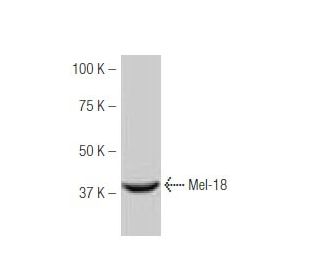

Mel-18 抗体 (9HL1): sc-130415. ヒト肝組織抽出液における Mel-18 発現をウエスタンブロットで解析.
Mel-18抗体(9HL1): sc-130415
- Mel-18抗体 (9HL1)はマウスモノクローナルIgG2a κです。100 µg/mlで提供
- human由来の組み換えMel-18に対応します
- human由来のMel-18 WB と IPでの検出にはお勧めします
- 現在、Mel-18 Antibody (9HL1)に適した二次検出試薬の同定はまだ完了していません。この研究は進めています。

クイックリンク
サポート品
説明
Gene情報
データシートとプロトコル
研究情報
関連項目
ショウジョウバエでは、ポリコーム(Pc-g)遺伝子ファミリーは、胚発生においてホメオティック遺伝子座の抑制に必要なクロマチンタンパク質をコードしている。ショウジョウバエのPc-gグループタンパク質のほ乳類ホモログであるMel-18とBmi-1は、発生過程で同様に発現し、遺伝子発現の制御、軸索骨格の形成、造血細胞の増殖と生存の制御に関与している。Mel-18はRING-fingerモチーフを介してDNAに直接結合し、Bcl-2、c-Myc、Hoxを含む様々な遺伝子の並置エンハンサーエレメントに優先的に結合する。Mel-18はc-Myc/Cdc25シグナルカスケード内の即時型初期応答遺伝子であり、腫瘍抑制活性を示し、S期進入をブロックすることによって細胞周期の進行を負に制御する。あるいは、Bmi-1は初期のリンパ球発生に関与する遺伝子の転写活性化に寄与することから、強力な癌遺伝子として同定されている。Bmi-1発現のプロウイルス活性化は、c-MycやPimを含む他のがん原遺伝子の遺伝子特異的な活性化の増強に対応し、その結果、リンパ腫発生の進行をもたらす。
試験・研究用以外には使用しないでください。 臨床及び体外診断には使用できません。
Alexa Fluor® はMolecular Probes Inc., OR., USAの商標です。
LI-COR® and Odyssey® はLI-COR Biosciencesの登録商標です。
Mel-18抗体(9HL1) 参考文献:
- Mel-18の低発現は乳癌患者の予後不良を予測する。 | Guo, BH., et al. 2010. Ann Oncol. 21: 2361-2369. PMID: 20444850
- 哺乳類のポリコーム遺伝子Mel-18は内皮細胞の血管新生遺伝子発現を制御する。 | Jung, JH., et al. 2010. Biochem Biophys Res Commun. 400: 523-30. PMID: 20801102
- MEL-18の喪失は、エストロゲン受容体-αのダウンレギュレーションとホルモン非依存性を媒介する。 | Lee, JY., et al. 2015. J Clin Invest. 125: 1801-14. PMID: 25822021
- MEL-18、進行性乳癌の癌抑制因子。 | Lee, JY. and Kong, G. 2015. Oncotarget. 6: 15710-1. PMID: 26158291
- Mel-18は胃癌においてmiR-21のダウンレギュレーションを介して幹細胞様特性を負に制御する。 | Wang, XF., et al. 2016. Oncotarget. 7: 63352-63361. PMID: 27542229
- 肺扁平上皮癌におけるMEL-18ではなくBMI-1発現の予後的意義。 | Abe, S., et al. 2017. Anticancer Res. 37: 1923-1929. PMID: 28373461
- 食道扁平上皮癌におけるMel-18とBmi-1の発現と臨床病理学的意義。 | Ji, H., et al. 2017. Technol Cancer Res Treat. 16: 828-834. PMID: 28425347
- BMI1とMEL18はREG3BとSTAT3を介してマウスの大腸炎関連がんを促進する。 | Liu, X., et al. 2017. Gastroenterology. 153: 1607-1620. PMID: 28780076
- 乳癌の抗HER2療法におけるMEL-18増幅の役割。 | Lee, JY., et al. 2019. J Natl Cancer Inst. 111: 609-619. PMID: 30265336
- AKTが介在するMel18リン酸化によるクロマチンユビキチン化と腫瘍形成の制御。 | Mai, J., et al. 2021. Oncogene. 40: 2422-2436. PMID: 33664452
注文情報
| 製品名 | カタログ # | 単位 | 価格 | 数量 | お気に入り | |
Mel-18 抗体 (9HL1) | sc-130415 | 100 µg/ml | $339.00 |