
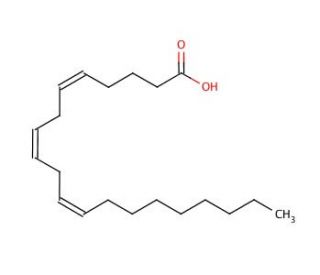

Mead Acid (CAS 20590-32-3)
QUICK LINKS
Mead Acid is an unsaturated fatty acid which is a precursor in the biosynthesis of prostaglandins, thromboxanes and leukotrienes (the eicosanoids comprising the "arachidonic cascade"). Large quantities of Mead Acid are found in cartilage. Mead Acid can be converted to 3-series cysteinyl-leukotrienes but cannot serve as a COX substrate. The kidneys from essential fatty acid deficient rats are less immunogenic when transplanted, and the metabolites of eicosatrienoic acid are believed to play a role in altering the immune status of these organs. Research has shown that Mead Acid has immunomodulatory and anti-inflammatory effects. Mead Acid is also known as 5(Z),8(Z),11(Z)-Eicosatrienoic acid, cis,cis,cis-5,8,11-Eicosatrienoic acid, and (5Z,8Z,11Z)-Eicosa-5,8,11-trienoic acid.
Mead Acid (CAS 20590-32-3) References
- Assessment of essential fatty acid and omega3-fatty acid status by measurement of erythrocyte 20:3omega9 (Mead acid), 22:5omega6/20:4omega6 and 22:5omega6/22:6omega3. | Fokkema, MR., et al. 2002. Prostaglandins Leukot Essent Fatty Acids. 67: 345-56. PMID: 12445496
- Trans isomeric octadecenoic acids are related inversely to arachidonic acid and DHA and positively related to mead acid in umbilical vessel wall lipids. | Decsi, T., et al. 2002. Lipids. 37: 959-65. PMID: 12530555
- Production of 5,8,11-Eicosatrienoic Acid (Mead Acid) by a (Delta)6 Desaturation Activity-Enhanced Mutant Derived from a (Delta)12 Desaturase-Defective Mutant of an Arachidonic Acid-Producing Fungus, Mortierella alpina 1S-4. | Kawashima, H., et al. 1997. Appl Environ Microbiol. 63: 1820-5. PMID: 16535598
- Structural requirements for activation of the 5-oxo-6E,8Z, 11Z,14Z-eicosatetraenoic acid (5-oxo-ETE) receptor: identification of a mead acid metabolite with potent agonist activity. | Patel, P., et al. 2008. J Pharmacol Exp Ther. 325: 698-707. PMID: 18292294
- Mildly abnormal general movement quality in infants is associated with higher Mead acid and lower arachidonic acid and shows a U-shaped relation with the DHA/AA ratio. | van Goor, SA., et al. 2010. Prostaglandins Leukot Essent Fatty Acids. 82: 15-20. PMID: 20022733
- Essential fatty acid deficiency: probing the role of arachidonate in biology. | Lefkowith, JB. 1990. Adv Prostaglandin Thromboxane Leukot Res. 20: 224-31. PMID: 2144697
- Identification of genes and pathways involved in the synthesis of Mead acid (20:3n-9), an indicator of essential fatty acid deficiency. | Ichi, I., et al. 2014. Biochim Biophys Acta. 1841: 204-13. PMID: 24184513
- Food allergy in small children carries a risk of essential fatty acid deficiency, as detected by elevated serum mead acid proportion of total fatty acids. | Paassilta, M., et al. 2014. Lipids Health Dis. 13: 180. PMID: 25440954
- Mead acid (20:3n-9) and n-3 polyunsaturated fatty acids are not associated with risk of posterior longitudinal ligament ossification: results of a case-control study. | Hamazaki, K., et al. 2015. Prostaglandins Leukot Essent Fatty Acids. 96: 31-6. PMID: 25669698
- Dietary effects of mead acid on N-methyl-N-nitrosourea-induced mammary cancers in female Sprague-Dawley rats. | Kinoshita, Y., et al. 2016. Biomed Rep. 4: 33-39. PMID: 26870330
- FADS2 inhibition in essential fatty acid deficiency induces hepatic lipid accumulation via impairment of very low-density lipoprotein (VLDL) secretion. | Hayashi, Y., et al. 2018. Biochem Biophys Res Commun. 496: 549-555. PMID: 29353041
- Essential fatty acid deficiency: a new look at an old problem. | Lefkowith, JB., et al. 1986. Prostaglandins Leukot Med. 23: 123-7. PMID: 3020581
- Dietary coconut oil ameliorates skin contact hypersensitivity through mead acid production in mice. | Tiwari, P., et al. 2019. Allergy. 74: 1522-1532. PMID: 30843234
- Essential fatty acid depletion of renal allografts and prevention of rejection. | Schreiner, GF., et al. 1988. Science. 240: 1032-3. PMID: 3285468
- Mead acid inhibits retinol-induced irritant contact dermatitis via peroxisome proliferator-activated receptor alpha. | Saika, A., et al. 2023. Front Mol Biosci. 10: 1097955. PMID: 36825199
Ordering Information
| Product Name | Catalog # | UNIT | Price | Qty | FAVORITES | |
Mead Acid, 1 mg | sc-200772 | 1 mg | $148.00 | |||
Mead Acid, 10 mg | sc-200772A | 10 mg | $695.00 |