
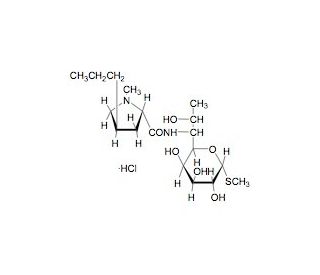

Lincomycin (U-10149A) 의 분자 구조, CAS 번호: 859-18-7
Lincomycin (U-10149A) (CAS 859-18-7)
대체 이름:
Lincomycin hydrochloride
적용:
Lincomycin (U-10149A) 박테리아의 단백질 합성 억제제입니다.
CAS 등록번호:
859-18-7
순도:
≥95%
분자량:
442.99
분자식:
C18H35ClN2O6S
연구용으로만 사용가능합니다. 진단이나 치료용으로 사용불가합니다.
* Refer to Certificate of Analysis for lot specific data.
빠른 링크
주문정보
설명
기술정보
안전정보
SDS 및 분석 증명서
링코마이신(U-10149A)은 박테리아 단백질 합성에 초점을 맞춘 연구, 특히 리보솜 기능 및 구조와 관련된 연구에서 자주 사용됩니다. 박테리아가 단백질을 합성하는 메커니즘과 이 과정을 방해할 수 있는 방법을 조사하는 데 유용한 도구로 사용됩니다. 링코마이신(U-10149A)과 관련된 연구는 종종 50S 리보솜 서브유닛과의 결합 상호작용을 조사하여 리보솜 억제의 분자 역학에 대한 통찰력을 제공합니다. 또한 링코마이신(U-10149A)은 박테리아의 내성 메커니즘을 이해하려는 연구에 활용되어 박테리아가 유전적 및 적응적 변화를 통해 이러한 억제를 우회하는 방법을 밝히는 데 도움을 줍니다. 또한 링코마이신(U-10149A)은 특히 토양과 수생태계에서 미생물 군집에 미치는 영향을 평가할 수 있는 환경 미생물학 연구에서도 중요한 역할을 합니다.
Lincomycin (U-10149A) (CAS 859-18-7) 참고자료
- 박테리아 리보솜 서브유닛 합성: 새로운 항생제 표적. | Champney, WS. 2001. Curr Drug Targets Infect Disord. 1: 19-36. PMID: 12455231
- 링코마이신 염산염 일수화물의 결정 및 분자 구조와 절대적 구성. | Rajeswaran, M. and Srikrishnan, T. 2004. Carbohydr Res. 339: 2111-5. PMID: 15358090
- 링코사미드: 화학 구조, 생합성, 작용 메커니즘, 내성 및 응용. | Spízek, J., et al. 2004. Adv Appl Microbiol. 56: 121-54. PMID: 15566978
- 처리된 꿀벌(Apis mellifera L.) 군집에서 추출한 꿀의 린코마이신 잔류물 고갈 및 흔들기 절차의 효과에 대한 연구. | Adams, SJ., et al. 2009. Anal Chim Acta. 637: 315-20. PMID: 19286045
- 디페리오다토-쿠페이트(III)-루미놀 시스템을 사용하여 혈청 내 린코마이신을 측정하는 유량 주입 화학 발광법. | Hu, Y., et al. 2011. Luminescence. 26: 313-8. PMID: 22021244
- 링코마이신 내성, 니코티아나 플럼바기니폴리아의 새로운 유형의 모계 유전 돌연변이. | Cséplő, A. and Maliga, P. 1982. Curr Genet. 6: 105-9. PMID: 24186475
- 마이크로 캡슐화된 락토바실러스 델브루에키가 마우스 장내 세균총에 미치는 영향에 대한 연구. | Sun, Q., et al. 2015. J Microencapsul. 32: 669-76. PMID: 26471401
- 수용액 및 정맥 주입액에서 린코마이신 염산염의 안정성 연구. | Czarniak, P., et al. 2016. Drug Des Devel Ther. 10: 1029-34. PMID: 27022242
- 오미자 다당류가 항생제 관련 설사를 가진 쥐에 미치는 영향. | Qi, Y., et al. 2019. Int J Biol Macromol. 124: 627-634. PMID: 30500495
- 제브라피쉬의 신경독성에 대한 린코마이신 염산염의 효과. | Cheng, B., et al. 2020. Ecotoxicol Environ Saf. 201: 110725. PMID: 32474209
- 당뇨병에 수반되는 장-폐 기능 장애는 NF-κB 신호 경로를 통해 폐 섬유화 변화로 이어집니다. | Wang, G., et al. 2021. Am J Pathol. 191: 838-856. PMID: 33705752
- 생쥐의 항생제 관련 설사에 대한 박테로이데스 기반 미생물제의 효과. | Guo, H., et al. 2021. Microorganisms. 9: PMID: 34946094
- 이온성 액체 전해질을 사용한 고성능 슈퍼 커패시터를 위한 폐기물 변환 질소 및 불소 코도핑 다공성 탄소 나노시트. | Chen, C., et al. 2022. J Colloid Interface Sci. 616: 413-421. PMID: 35220188
- 파낙스 퀸퀘폴리우스 다당류는 MAPK 신호 전달 경로를 통해 쥐에서 링코마이신 염산염에 의해 유도된 항생제 관련 설사를 개선합니다. | Ren, DD., et al. 2022. J Immunol Res. 2022: 4126273. PMID: 35345778
- 개의 표재성 농피증 치료에서 린코마이신 염산염과 클린다마이신 염산염의 비교. | Harvey, RG., et al. 1993. Vet Rec. 132: 351-3. PMID: 8488640
의 억제제:
Ribosomal Protein LP0.주문정보
| 제품명 | 카탈로그 번호 | 단위 | 가격 | 수량 | 관심품목 | |
Lincomycin (U-10149A), 1 g | sc-200105 | 1 g | $74.00 | |||
Lincomycin (U-10149A), 5 g | sc-200105A | 5 g | $274.00 | |||
Lincomycin (U-10149A), 25 g | sc-200105B | 25 g | $983.00 |