
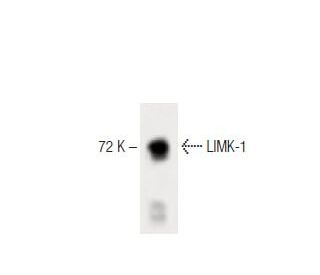


LIMK-1 Antibody (42): sc-135973
- LIMK-1 Antibody (42) is a mouse monoclonal IgG1 provided at 50 µg/0.5 ml
- raised against amino acids 232-333 of LIMK-1 of human origin
- recommended for detection of LIMK-1 of mouse, rat and human origin by WB, IP and IF
- At present, we have not yet completed the identification of the preferred secondary detection reagent(s) for LIMK-1 Antibody (42). This work is in progress.

LIMK-1 Antibody (42) is a mouse monoclonal IgG1 antibody that detects LIMK-1 in mouse, rat, and human samples through applications such as western blotting (WB), immunoprecipitation (IP), and immunofluorescence (IF). LIMK-1, a member of the LIM kinase family, plays a crucial role in regulating actin cytoskeleton dynamics, which is essential for various cellular processes including cell motility, morphogenesis, and neuronal differentiation. By phosphorylating and inhibiting Cofilin, LIMK-1 stabilizes F-actin structures, thereby influencing cell shape and movement. Such regulation is particularly important in developmental processes and cancer metastasis, where altered cell motility can lead to increased invasiveness. Expression patterns of LIMK-1 and LIMK-2 suggest distinct roles during development, with anti-LIMK-1 antibody (42) revealing LIMK-1′s involvement in inhibiting neuronal differentiation in PC12 cells by interfering with downstream signaling events of MAPK activation. The identification of a truncated form of LIMK-2 in adult testis, arising from an alternative initiation exon, highlights the complexity and potential functional diversity within this protein family. LIMK-1 (42) monoclonal antibody serves as an invaluable tool for researchers studying cell signaling and cytoskeletal dynamics.
Alexa Fluor® is a trademark of Molecular Probes Inc., OR., USA
LI-COR® and Odyssey® are registered trademarks of LI-COR Biosciences
LIMK-1 Antibody (42) References:
- Targeting LIM kinase in cancer and neurofibromatosis. | Rak, R. and Kloog, Y. 2014. Cell Cycle. 13: 1360-1. PMID: 24698779
- Bis-aryl urea derivatives as potent and selective LIM kinase (Limk) inhibitors. | Yin, Y., et al. 2015. J Med Chem. 58: 1846-61. PMID: 25621531
- Lim kinase, a bi-functional effector in injury-induced structural plasticity of synapses. | Wang, W. and Townes-Anderson, E. 2016. Neural Regen Res. 11: 1029-32. PMID: 27630670
- Targeting ROCK/LIMK/cofilin signaling pathway in cancer. | Lee, MH., et al. 2019. Arch Pharm Res. 42: 481-491. PMID: 31030376
- LIMK (LIM Kinase) Inhibition Prevents Vasoconstriction- and Hypertension-Induced Arterial Stiffening and Remodeling. | Morales-Quinones, M., et al. 2020. Hypertension. 76: 393-403. PMID: 32594801
- Small Molecules as LIM Kinase Inhibitors. | Bukhari, SNA., et al. 2022. Curr Med Chem. 29: 2995-3027. PMID: 34702151
- Structural Aspects of LIMK Regulation and Pharmacology. | Chatterjee, D., et al. 2022. Cells. 11: PMID: 35011704
- LIMK-1 and LIMK-2, two members of a LIM motif-containing protein kinase family. | Nunoue, K., et al. 1995. Oncogene. 11: 701-10. PMID: 7651734
- The murine LIM-kinase gene (limk) encodes a novel serine threonine kinase expressed predominantly in trophoblast giant cells and the developing nervous system. | Cheng, AK. and Robertson, EJ. 1995. Mech Dev. 52: 187-97. PMID: 8541208
- Comparison of tissue distribution of two novel serine/threonine kinase genes containing the LIM motif (LIMK-1 and LIMK-2) in the developing rat. | Mori, T., et al. 1997. Brain Res Mol Brain Res. 45: 247-54. PMID: 9149099
Ordering Information
| Product Name | Catalog # | UNIT | Price | Qty | FAVORITES | |
LIMK-1 Antibody (42) | sc-135973 | 50 µg/0.5 ml | $322.00 |