
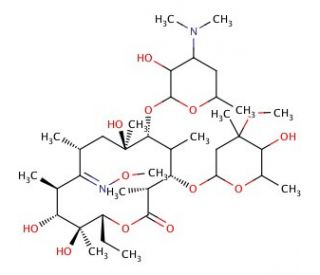

Lexithromycin (CAS 53066-26-5)
QUICK LINKS
Lexithromycin is a compound of interest in the area of biochemical research, where it is studied for its role as an inhibitor of bacterial protein synthesis. In research applications, it serves as a tool for probing the function of ribosomal translocation and the mechanics of protein assembly within bacterial cells. Investigations using Lexithromycin aim to elucidate its mechanism of action at a molecular level, revealing how it interacts with ribosomal subunits to impede the growth of bacteria. Such studies contribute to a broader understanding of ribosomal function and protein synthesis. Furthermore, Lexithromycin is utilized in structural biology to help clarify the conformational changes in ribosomes during the translation process, providing insights that are valuable for the advancement of molecular biology techniques and knowledge.
Lexithromycin (CAS 53066-26-5) References
- The new macrolide antibiotics: azithromycin, clarithromycin, dirithromycin, and roxithromycin. | Bahal, N. and Nahata, MC. 1992. Ann Pharmacother. 26: 46-55. PMID: 1318761
- Roxithromycin-induced toxic epidermal necrolysis. | Das, S., et al. 2012. Ther Drug Monit. 34: 359-62. PMID: 22777150
- Roxithromycin inhibits nuclear factor kappaB signaling and endoplasmic reticulum stress in intestinal epithelial cells and ameliorates experimental colitis in mice. | Choi, Y., et al. 2015. Exp Biol Med (Maywood). 240: 1664-71. PMID: 26088864
- Roxithromycin-loaded lipid nanoparticles for follicular targeting. | Wosicka-Frąckowiak, H., et al. 2015. Int J Pharm. 495: 807-15. PMID: 26456292
- Macrolide antibiotics for bronchiectasis. | Kelly, C., et al. 2018. Cochrane Database Syst Rev. 3: CD012406. PMID: 29543980
- Single and combined effects of microplastics and roxithromycin on Daphnia magna. | Zhang, P., et al. 2019. Environ Sci Pollut Res Int. 26: 17010-17020. PMID: 30972681
- Impact of roxithromycin on waste activated sludge anaerobic digestion: Methane production, carbon transformation and antibiotic resistance genes. | Ni, BJ., et al. 2020. Sci Total Environ. 703: 134899. PMID: 31757536
- Roxithromycin inhibits compound 48/80-induced pseudo-allergy via the MrgprX2 pathway both in vitro and in vivo. | Zhang, Y., et al. 2020. Cell Immunol. 358: 104239. PMID: 33129497
- Effect of roxithromycin on contractile activity of gastrointestinal smooth muscles in colitic rats. | Kumar, VL., et al. 2021. J Basic Clin Physiol Pharmacol. 32: 1083-1086. PMID: 33559463
- Preparation and characterization of DNA aptamers against roxithromycin. | Jiang, L., et al. 2021. Anal Chim Acta. 1164: 338509. PMID: 33992220
- Intergenerational and biological effects of roxithromycin and polystyrene microplastics to Daphnia magna. | Liu, J., et al. 2022. Aquat Toxicol. 248: 106192. PMID: 35617774
- Combined toxicity of erythromycin and roxithromycin and their removal by Chlorella pyrenoidosa. | Liu, K., et al. 2023. Ecotoxicol Environ Saf. 257: 114929. PMID: 37084660
- Roxithromycin. An update of its antimicrobial activity, pharmacokinetic properties and therapeutic use. | Markham, A. and Faulds, D. 1994. Drugs. 48: 297-326. PMID: 7527329
- Roxithromycin-induced digoxin toxicity. | Corallo, CE. and Rogers, IR. 1996. Med J Aust. 165: 433-4. PMID: 8913245
- Roxithromycin: review of its antimicrobial activity. | Bryskier, A. 1998. J Antimicrob Chemother. 41 Suppl B: 1-21. PMID: 9579708
Ordering Information
| Product Name | Catalog # | UNIT | Price | Qty | FAVORITES | |
Lexithromycin, 5 mg | sc-391632 | 5 mg | $235.00 |