
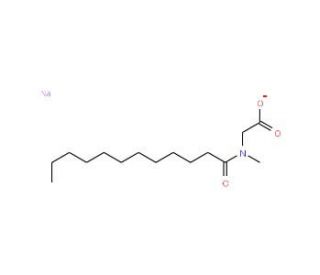

Lauroylsarcosine, Sodium Salt (CAS 137-16-6)
QUICK LINKS
Lauroylsarcosine, Sodium Salt, commonly known as LS, is a zwitterionic surfactant with a unique amphiphilic structure, making it a valuable tool in various scientific research domains. Its mechanism of action involves the disruption of lipid-protein interactions and solubilization of membrane proteins. LS has been extensively utilized in biochemistry and molecular biology for its ability to efficiently solubilize and extract membrane proteins from biological membranes, facilitating their purification and characterization. Furthermore, LS is employed in protein research for its compatibility with downstream analytical techniques such as chromatography and mass spectrometry. In addition to its role in membrane protein studies, LS finds applications in cell biology, where it is used to permeabilize cell membranes for intracellular delivery of macromolecules such as proteins and nucleic acids. Its mild detergent properties and low cytotoxicity make LS a preferred choice in cell culture experiments and in the preparation of functional lipid bilayers for biophysical studies. Ongoing research continues to explore novel applications and modifications of LS, underscoring its importance in advancing scientific understanding across various research disciplines.
Lauroylsarcosine, Sodium Salt (CAS 137-16-6) References
- Recombinase polymerase amplification (RPA) combined with lateral flow (LF) strip for equipment-free detection of Cryptosporidium spp. oocysts in dairy cattle feces. | Wu, YD., et al. 2016. Parasitol Res. 115: 3551-5. PMID: 27174027
- A novel detergent-based decellularization combined with carbodiimide crosslinking for improving anti-calcification of bioprosthetic heart valve. | Luo, Y., et al. 2021. Biomed Mater. 16: PMID: 33979785
- Membrane Proteins and Proteomics of Cronobacter sakazakii Cells: Reliable Method for Identification and Subcellular Localization. | Novotný, J., et al. 2022. Appl Environ Microbiol. 88: e0250821. PMID: 35435719
- An efficient Pulsed-Field Gel Electrophoresis (PFGE) method for typing autolytic Lacticaseibacillus rhamnosus strains. | Heikkinen, J., et al. 2022. MethodsX. 9: 101945. PMID: 36505100
- Phase variable acetylation of lipooligosaccharide modifies antibody production and opsonophagocytic killing of non-typeable Haemophilus influenzae. | Wills, BM., et al. 2023. iScience. 26: 107785. PMID: 37727736
- Major latex-like proteins show pH dependency in their binding to hydrophobic organic pollutants. | Fujita, K., et al. 2023. J Pestic Sci. 48: 71-77. PMID: 37745171
- Designing Nanomedicines for Breast Cancer Therapy. | Abbasi Dezfouli, S., et al. 2023. Biomolecules. 13: PMID: 37892241
- Visualizing DNA replication by single-molecule analysis of replicated DNA. | Madireddy, A. and Gerhardt, J. 2023. STAR Protoc. 4: 102721. PMID: 38048218
- Synthesis, Crystal Structures, Genotoxicity, and Antifungal and Antibacterial Studies of Ni(II) and Cd(II) Pyrazole Amide Coordination Complexes. | El Mahdaoui, A., et al. 2024. Molecules. 29: PMID: 38474698
- A Comprehensive Study on Folate-Targeted Mesoporous Silica Nanoparticles Loaded with 5-Fluorouracil for the Enhanced Treatment of Gynecological Cancers. | Almomen, A. and Alhowyan, A. 2024. J Funct Biomater. 15: PMID: 38535267
Ordering Information
| Product Name | Catalog # | UNIT | Price | Qty | FAVORITES | |
Lauroylsarcosine, Sodium Salt, 1 g | sc-280907 | 1 g | $175.00 |