
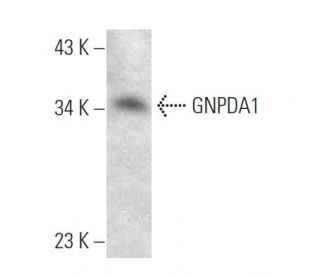

GNPDA1 Antibody (237CT2.5.2): sc-517332
- GNPDA1 Antibody (237CT2.5.2) is a mouse monoclonal IgG1 κ GNPDA1 antibody provided at 100 µg/ml
- raised against a recombinant protein corresponding to GNPDA1 of human origin
- recommended for detection of GNPDA1 of mouse, rat and human origin by WB and IP
- At present, we have not yet completed the identification of the preferred secondary detection reagent(s) for GNPDA1 Antibody (237CT2.5.2). This work is in progress.

QUICK LINKS
SEE ALSO...
GNPDA1 Antibody (237CT2.5.2) is a mouse monoclonal IgG1 kappa light chain antibody that detects GNPDA1 protein of mouse, rat, and human origin by western blotting (WB) and immunoprecipitation (IP). Anti-GNPDA1 antibody (237CT2.5.2) is available as a non-conjugated format. GNPDA1 (237CT2.5.2) antibody recognizes a protein that plays a crucial role in cellular metabolism, specifically in the conversion of glucosamine-6-phosphate to fructose-6-phosphate and ammonia, which is essential for proper functioning of various metabolic pathways. GNPDA1 monoclonal antibody (237CT2.5.2) targets a protein that is abundantly expressed in tissues with high metabolic demands, such as testis, ovary, and heart. GNPDA1 exists as a homohexamer, which is vital for enzymatic function, and activity is regulated by various factors, including post-translational modifications that influence stability and protein interactions. Understanding GNPDA1′s function and regulation is important for elucidating its role in reproductive biology and metabolic disorders, making anti-GNPDA1 antibody (237CT2.5.2) a valuable research tool.
Alexa Fluor® is a trademark of Molecular Probes Inc., OR., USA
LI-COR® and Odyssey® are registered trademarks of LI-COR Biosciences
GNPDA1 Antibody (237CT2.5.2) References:
- Characterization of testicular mouse glucosamine 6-phosphate deaminase (GNPDA). | Montag, M., et al. 1999. FEBS Lett. 458: 141-4. PMID: 10481053
- Cloning, sequencing, and expression analysis of mouse glucosamine-6-phosphate deaminase (GNPDA/oscillin). | Amireault, P. and Dubé, F. 2000. Mol Reprod Dev. 56: 424-35. PMID: 10862010
- Cloning and functional characterization of GNPI2, a novel human homolog of glucosamine-6-phosphate isomerase/oscillin. | Zhang, J., et al. 2003. J Cell Biochem. 88: 932-40. PMID: 12616532
- Phlegm-dampness constitution: genomics, susceptibility, adjustment and treatment with traditional Chinese medicine. | Wang, J., et al. 2013. Am J Chin Med. 41: 253-62. PMID: 23548117
- Identification of differential proteins in colorectal cancer cells treated with caffeic acid phenethyl ester. | He, YJ., et al. 2014. World J Gastroenterol. 20: 11840-9. PMID: 25206290
- Hexosamine biosynthesis in keratinocytes: roles of GFAT and GNPDA enzymes in the maintenance of UDP-GlcNAc content and hyaluronan synthesis. | Oikari, S., et al. 2016. Glycobiology. 26: 710-22. PMID: 26887390
- Glucosamine-6-Phosphate Isomerase 1 Promotes Tumor Progression and Indicates Poor Prognosis in Hepatocellular Carcinoma. | Li, D., et al. 2020. Cancer Manag Res. 12: 4923-4935. PMID: 32606980
- The Possible Roles of Glucosamine-6-Phosphate Deaminases in Ammonium Metabolism in Cancer. | Lara-Lemus, R., et al. 2024. Int J Mol Sci. 25: PMID: 39596123
- Calcium oscillations in mammalian eggs triggered by a soluble sperm protein. | Parrington, J., et al. 1996. Nature. 379: 364-8. PMID: 8552195
- Molecularly cloned mammalian glucosamine-6-phosphate deaminase localizes to transporting epithelium and lacks oscillin activity. | Wolosker, H., et al. 1998. FASEB J. 12: 91-9. PMID: 9438414
- A novel protein for Ca2+ signaling at fertilization. | Parrington, J., et al. 1998. Curr Top Dev Biol. 39: 215-43. PMID: 9476002
- The human glucosamine-6-phosphate deaminase gene: cDNA cloning and expression, genomic organization and chromosomal localization. | Shevchenko, V., et al. 1998. Gene. 216: 31-8. PMID: 9714720
Ordering Information
| Product Name | Catalog # | UNIT | Price | Qty | FAVORITES | |
GNPDA1 Antibody (237CT2.5.2) | sc-517332 | 100 µg/ml | $322.00 |