
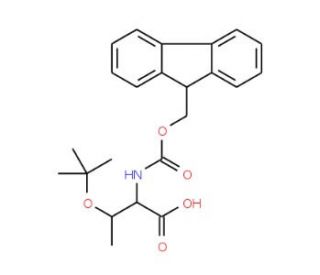

Fmoc-Thr(tBu)-OH (CAS 71989-35-0)
QUICK LINKS
Fmoc-Thr(tBu)-OH, also referred to as 2-Fmoc-L-threonine tert-butyl ester hydrochloride, is a derivative of an amino acid utilized in peptide synthesis and various other biochemical applications. Essentially, it is a modified version of L-threonine, a naturally occurring amino acid, with a tert-butyl ester group attached to its N-terminal end. This alteration enhances stability and makes it easier to handle during laboratory experiments. As a result, Fmoc-Thr(tBu)-OH finds extensive use in scientific research, ranging from protein and peptide synthesis to enzymatic reactions and drug delivery systems. The applications of Fmoc-Thr(tBu)-OH are diverse, spanning across various scientific realms. In protein and peptide synthesis, its stability and ease of handling make it a valuable component. Furthermore, it plays a role in enzymatic reactions, aiding in the synthesis of peptides and proteins, and even finds applications in drug delivery systems. Additionally, researchers have harnessed its potential to investigate cellular processes, such as signal transduction, and explore protein-protein interactions. Though the exact mechanism of action remains somewhat elusive, the attachment of the tert-butyl ester group to the N-terminal end is believed to empower Fmoc-Thr(tBu)-OH with a heightened stability when interacting with proteins and enzymes. This increased stability is what makes it suitable for diverse scientific research applications.
Fmoc-Thr(tBu)-OH (CAS 71989-35-0) References
- Replacement of the intervening amino acid sequence of a Syk-binding diphosphopeptide by a nonpeptide spacer with preservation of high affinity. | Dekker, FJ., et al. 2002. Chembiochem. 3: 238-42. PMID: 11921404
- Improvement of pharmacokinetics of radioiodinated Tyr(3)-octreotide by conjugation with carbohydrates. | Schottelius, M., et al. 2002. Bioconjug Chem. 13: 1021-30. PMID: 12236784
- Resolution of tert-butyl-1-(2-methyinaphthyl)phosphine oxide using selectors identified from a chemical combinatorial library. | Blodgett, J., et al. 2002. Anal Chem. 74: 5212-6. PMID: 12403573
- Realities of high-throughput liquid chromatography/mass spectrometry purification of large combinatorial libraries: a report on overall sample throughput using parallel purification. | Isbell, J., et al. 2002. J Comb Chem. 4: 600-11. PMID: 12425605
- Conformational constraint in protein ligand design and the inconsistency of binding entropy. | Udugamasooriya, DG. and Spaller, MR. 2008. Biopolymers. 89: 653-67. PMID: 18335423
- In vitro and in vivo pharmacological characterization of a neuropeptide S tetrabranched derivative. | Ruzza, C., et al. 2015. Pharmacol Res Perspect. 3: e00108. PMID: 25692025
- Stereoselective Polymer-Supported Synthesis of Morpholine- and Thiomorpholine-3-carboxylic Acid Derivatives. | Králová, P., et al. 2017. ACS Comb Sci. 19: 173-180. PMID: 28085245
- Polymer-Supported Stereoselective Synthesis of Benzoxazino[4,3-b][1,2,5]thiadiazepinone 6,6-dioxides. | Králová, P., et al. 2017. ACS Comb Sci. 19: 670-674. PMID: 28825802
- Conventional and high-yield synthesis of DTPA-conjugated peptides: application of a monoreactive DTPA to DTPA-D-Phe1-octreotide synthesis. | Arano, Y., et al. 1997. Bioconjug Chem. 8: 442-6. PMID: 9177852
Ordering Information
| Product Name | Catalog # | UNIT | Price | Qty | FAVORITES | |
Fmoc-Thr(tBu)-OH, 1 g | sc-250019 | 1 g | $34.00 | |||
Fmoc-Thr(tBu)-OH, 10 g | sc-250019A | 10 g | $98.00 | |||
Fmoc-Thr(tBu)-OH, 100 g | sc-250019B | 100 g | $249.00 | |||
Fmoc-Thr(tBu)-OH, 500 g | sc-250019C | 500 g | $582.00 |