
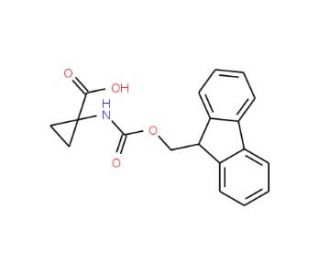

Fmoc-1-aminocyclopropane-1-carboxylic acid (CAS 126705-22-4)
Direktverknüpfungen
Fmoc-1-Aminocyclopropan-1-carboxylsäure, allgemein als FMOC-CPA bezeichnet, erweist sich als bemerkenswerter nicht-natürlicher Aminosäure, der in der Synthese von Peptiden, Peptidomimetika und Proteinen weit verbreitet eingesetzt wird. Sie findet Anwendung in der Peptid- und Peptidomimetik-Synthese, um Proteine und andere biologisch aktive Moleküle zu erzeugen. Darüber hinaus nutzen Forscher ihr Potenzial, um die Struktur und Funktion von Proteinen zu untersuchen und Enzym-katalysierte Reaktionen zu erforschen. Die einzigartigen Eigenschaften von Fmoc-1-Aminocyclopropan-1-carboxylsäure unterstreichen ihre Bedeutung für Wissenschaftler und Forscher. Die Fluorenyl-Gruppe, die als Elektronendonator fungiert, ermöglicht die Bildung einer stabilen kovalenten Bindung zwischen Fmoc-1-Aminocyclopropan-1-carboxylsäure und dem Peptid. Darüber hinaus trägt die Methoxycarbonyl-Gruppe, die ebenfalls als Elektronendonator fungiert, zur Stabilisierung der Bindung bei. Darüber hinaus verleiht die Cyclopropanierung des Zwischenprodukts der resultierenden Bindung zusätzliche Stabilität, was die allgemeine Wirksamkeit von FMOC-CPA als Forschungswerkzeug erhöht.
Fmoc-1-aminocyclopropane-1-carboxylic acid (CAS 126705-22-4) Literaturhinweise
- Tetrapeptide als potente Proteaseinhibitoren des Hepatitis-C-Virus in voller Länge NS3 (Protease-Helicase/NTPase). | Johansson, A., et al. 2002. Bioorg Med Chem. 10: 3915-22. PMID: 12413843
- Die Wechselwirkungen des antimikrobiellen Beta-Peptids Beta-17 mit Phospholipidvesikeln unterscheiden sich von den Membranwechselwirkungen der Magainine. | Epand, RF., et al. 2003. Eur J Biochem. 270: 1240-8. PMID: 12631282
- Hemmung der Gamma-Sekretase-Aktivität durch helikale Beta-Peptid-Foldamere. | Imamura, Y., et al. 2009. J Am Chem Soc. 131: 7353-9. PMID: 19432477
- Auswirkung der helikalen Konformation und der Seitenkettenstruktur auf die Hemmung der γ-Sekretase durch β-Peptid-Faltamere: Einblick in die Substraterkennung. | Imamura, Y., et al. 2013. J Med Chem. 56: 1443-54. PMID: 23342950
- Entwurf, Synthese und Anwendung von kombinatorischen OB2C-Peptid- und Peptidomimetik-Bibliotheken. | Liu, R., et al. 2015. Methods Mol Biol. 1248: 3-22. PMID: 25616322
- Iterativer nichtproteinogener Einbau von Resten ergibt α/β-Peptide mit einer Helix-Loop-Helix-Tertiärstruktur und hoher Affinität für VEGF. | Checco, JW. and Gellman, SH. 2017. Chembiochem. 18: 291-299. PMID: 27897370
- Unerwünschte Hydrolyse oder Bildung von α/β-Peptidbindungen: Wie lange sollte der geschwindigkeitslimitierende Kopplungsschritt dauern? | Goldschmidt Gőz, V., et al. 2019. RSC Adv. 9: 30720-30728. PMID: 35529379
Bestellinformation
| Produkt | Katalog # | EINHEIT | Preis | ANZAHL | Favoriten | |
Fmoc-1-aminocyclopropane-1-carboxylic acid, 1 g | sc-294705 | 1 g | $151.00 | |||
Fmoc-1-aminocyclopropane-1-carboxylic acid, 5 g | sc-294705A | 5 g | $887.00 |