
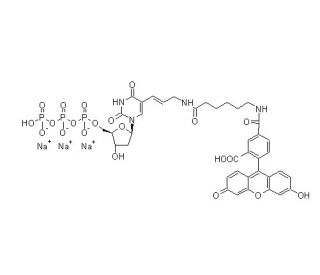

Fluorescein-dUTP (CAS 214154-36-6)
QUICK LINKS
Fluorescein-dUTP 1 mM in Tris Buffer (pH 7.5) is a compound used primarily in molecular biology research for the labeling of nucleic acids. The inclusion of fluorescein allows for the direct detection of the incorporated nucleotide via fluorescence microscopy or flow cytometry. This compound is instrumental in techniques such as fluorescence in situ hybridization (FISH), where it enables the visualization of specific DNA sequences within chromosomes. In addition, it is utilized in real-time PCR assays to monitor the amplification of target DNA sequences, as the fluorescein moiety provides a fluorescent signal that increases proportionally with the amount of DNA synthesized. The stabilization of Fluorescein-dUTP in Tris buffer at a neutral pH ensures that it is in an optimal condition for enzymatic reactions, which is critical for maintaining the fidelity and efficiency of nucleic acid synthesis during various molecular biology protocols.
Fluorescein-dUTP (CAS 214154-36-6) References
- High affinity binding of fluorescein isothiocyanate to eosinophils detected by laser scanning cytometry: a potential source of error in analysis of blood samples utilizing fluorescein-conjugated reagents in flow cytometry. | Bedner, E., et al. 1999. Cytometry. 36: 77-82. PMID: 10331630
- Plasminogen activator inhibitor 1 may promote tumour growth through inhibition of apoptosis. | Kwaan, HC., et al. 2000. Br J Cancer. 82: 1702-8. PMID: 10817507
- Multilocus sequence typing of Staphylococcus aureus with DNA array technology. | van Leeuwen, WB., et al. 2003. J Clin Microbiol. 41: 3323-6. PMID: 12843083
- Eicosapentaenoic acid prevents LPS-induced TNF-alpha expression by preventing NF-kappaB activation. | Zhao, Y., et al. 2004. J Am Coll Nutr. 23: 71-8. PMID: 14963056
- HIV-1 induces cardiomyopathyby cardiomyocyte invasion and gp120, Tat, and cytokine apoptotic signaling. | Fiala, M., et al. 2004. Cardiovasc Toxicol. 4: 97-107. PMID: 15371627
- Use of laptop computers connected to internet through Wi-Fi decreases human sperm motility and increases sperm DNA fragmentation. | Avendaño, C., et al. 2012. Fertil Steril. 97: 39-45.e2. PMID: 22112647
- Mitophagy is a protective response against oxidative damage in bone marrow mesenchymal stem cells. | Fan, P., et al. 2019. Life Sci. 229: 36-45. PMID: 31085242
- Fluorescein-based monitoring of RNA N6-methyladenosine at single-nucleotide resolution. | Liu, XM., et al. 2021. J Mol Cell Biol. 13: 325-328. PMID: 33064831
- Primer-induced labeling of pea and field bean chromosomes in situ and in suspension. | Macas, J., et al. 1995. Biotechniques. 19: 402-4; 407-8. PMID: 7495553
- Multiple and sensitive fluorescence in situ hybridization with rhodamine-, fluorescein-, and coumarin-labeled DNAs. | Wiegant, J., et al. 1993. Cytogenet Cell Genet. 63: 73-6. PMID: 8449043
- Detection of apoptosis at the single-cell level by direct incorporation of fluorescein-dUTP in DNA strand breaks. | Piqueras, B., et al. 1996. Biotechniques. 20: 634-40. PMID: 8800683
- RNA synthesis and splicing interferes with DNA in situ end labeling techniques used to detect apoptosis. | Kockx, MM., et al. 1998. Am J Pathol. 152: 885-8. PMID: 9546348
- Quantitative PCR for Listeria monocytogenes with colorimetric detection. | Wang, C. and Hong, C. 1999. J Food Prot. 62: 35-9. PMID: 9921826
Ordering Information
| Product Name | Catalog # | UNIT | Price | Qty | FAVORITES | |
Fluorescein-dUTP, 25 nmol | sc-391125 | 25 nmol | $370.00 |