
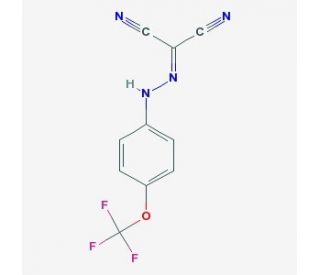

Molecular structure of FCCP, CAS Number: 370-86-5
FCCP (CAS 370-86-5)
See product citations (46)
Alternate Names:
FCCP is also known as Carbonyl cyanide 4-(trifluoromethoxy)phenylhydrazone.
Application:
FCCP is a very potent oxidative phosphorylation uncoupler found in mitochondria.
CAS Number:
370-86-5
Purity:
≥95%
Molecular Weight:
254.17
Molecular Formula:
C10H5F3N4O
Supplemental Information:
This is classified as a Dangerous Good for transport and may be subject to additional shipping charges.
For Research Use Only. Not Intended for Diagnostic or Therapeutic Use.
* Refer to Certificate of Analysis for lot specific data.
QUICK LINKS
Ordering Information
Product Citations
Description
Technical Information
Safety Information
SDS & Certificate of Analysis
FCCP is an oxidative phosphorylation uncoupler in mitochondria that is capable of depolarizing plasma and mitochondrial membranes. FCCP disrupts ATP synthesis by transporting protons across cell membranes. It induces complete depolymerization of microtubules at 40 µM by increasing intracellular pH via the disruption of the mitochondrial H+ gradient and by decreasing the stability of microtubules by impairing the binding of microtubule-associated proteins. FCCP is also known as Carbonyl cyanide 4-(trifluoromethoxy)phenylhydrazone, and 2-[2-[4-(trifluoromethoxy)phenyl]hydrazinylidene]-propanedinitrile.
FCCP (CAS 370-86-5) References
- Novel effects of FCCP [carbonyl cyanide p-(trifluoromethoxy)phenylhydrazone] on amyloid precursor protein processing. | Connop, BP., et al. 1999. J Neurochem. 72: 1457-65. PMID: 10098849
- Effects of minimally toxic levels of carbonyl cyanide P-(trifluoromethoxy) phenylhydrazone (FCCP), elucidated through differential gene expression with biochemical and morphological correlations. | Kuruvilla, S., et al. 2003. Toxicol Sci. 73: 348-61. PMID: 12700400
- A new class of uncoupling agents--carbonyl cyanide phenylhydrazones. | HEYTLER, PG. and PRICHARD, WW. 1962. Biochem Biophys Res Commun. 7: 272-5. PMID: 13907155
- Carbonyl cyanide p-(trifluoromethoxy) phenylhydrazone (FCCP) as an O2(*-) generator induces apoptosis via the depletion of intracellular GSH contents in Calu-6 cells. | Han, YH., et al. 2009. Lung Cancer. 63: 201-9. PMID: 18585819
- Effects of carbonyl cyanide p-(trifluoromethoxy) phenylhydrazone on the growth inhibition in human pulmonary adenocarcinoma Calu-6 cells. | Han, YH., et al. 2009. Toxicology. 265: 101-7. PMID: 19819288
- Carbonyl cyanide p-(trifluoromethoxy) phenylhydroazone induces caspase-independent apoptosis in As4.1 juxtaglomerular cells. | Han, YH., et al. 2010. Anticancer Res. 30: 2863-8. PMID: 20683024
- Effect of carbonylcyanide-4-(trifluoromethoxy)phenylhydrazone (FCCP) on the interaction of 1-anilino-8-naphthalene sulfonate (ANS) with phosphatidylcholine liposomes. | Cutró, AC., et al. 2014. J Bioenerg Biomembr. 46: 119-25. PMID: 24570377
- Loss of mitochondrial transmembrane potential and glutathione depletion are not sufficient to account for induction of apoptosis by carbonyl cyanide 4-(trifluoromethoxy)phenylhydrazone in human leukemia K562 cells. | Mlejnek, P. and Dolezel, P. 2015. Chem Biol Interact. 239: 100-10. PMID: 26115783
- Carbonyl cyanide 4-(trifluoromethoxy)phenylhydrazone (FCCP) pre-exposure ensures follicle integrity during in vitro culture of ovarian tissue but not during cryopreservation in the domestic cat model. | Tanpradit, N., et al. 2016. J Assist Reprod Genet. 33: 1621-1631. PMID: 27639998
- Inhibition of chemical oxidation and reduction of cytochromes f and b-559 by carbonylcyanide p-trifluoromethoxy phenylhydrazone. | Cramer, WA., et al. 1974. Biochim Biophys Acta. 368: 361-70. PMID: 4451656
- [Effect of p-trifluoromethoxy-phenylhydrazone of carbonylcyanide on the kinetics of dicarboxylic acid uptake in rat liver mitochondria]. | Prezioso, G., et al. 1971. Boll Soc Ital Biol Sper. 47: 637-41. PMID: 5143112
- Uncouplers of rat-liver mitochondrial oxidative phosphorylation. | Parker, VH. 1965. Biochem J. 97: 658-62. PMID: 5881655
- The effect of carbonyl cyanide p-trifluoromethoxy-phenylhydrazone on yeast cells. | Kovác, L. and Hrusovská, E. 1967. Folia Microbiol (Praha). 12: 56-63. PMID: 6031585
- The molecular mechanism of action of the proton ionophore FCCP (carbonylcyanide p-trifluoromethoxyphenylhydrazone). | Benz, R. and McLaughlin, S. 1983. Biophys J. 41: 381-98. PMID: 6838976
Inhibitor of:
1810026J23Rik, 1810043H04Rik, 4930420K17Rik, 4930443G12Rik, ANT3, apoOL, ATP5, ATP5ATP5L2, ATP5C1, ATP5E, ATP5I, ATP5S, ATP6V0E1, ATP8, ATPAF2, ATPIF1, BCS1L, BRP44L, C10orf88, C11orf83, C17orf85, C20orf7, C20orf95, C6orf100, C7orf73, CCDC109A, CHPPR, Clpb, copine 6, Cstad, CTL3, D10Jhu81e, EF-G2, EG546368, FAHD1, FAM113B, FAM173A, FAM173B, FASTKD2, FDX1L, GABP-β1, GDAP1, GDAP1L1, GK3P, GTPBP5, GUF1, HCCR-1, HDMCP, HIGD1A, HSP 75, KIAA1143, Magmas, MCART6, Metaxin 3, MFF, MFSD5, Misato, Mitochondrial Inner Membrane, Mitochondrial Marker, Mitofilin, Mot1, Mtch2, MTERFD2, MTG1, MTO1, mtp110, MUL1, NDUFAF7, NDUFB7, NDUFB9, NIPSNAP3A, Olfr649, OPA3, ORNT2, OSAP, p60 Mitochondrial Marker, PEPT1, PRELI, PRELID2, PTRH2, QIL1, RMND1, SCaMC-1, SLC17A (solute carrier family 17), SLC17A2, SLC25A21, SLC25A22, SLC25A25, SLC25A33, SLC25A34, SLC25A36, SLC25A40, SLC25A41, SLC25A42, SLC25A43, SLC25A44, SLC43A3, SMCR7L, SNAT6, SPATA18, Syntaphilin, TAMM41, TBC1D20, TFB1M, Tim13A/B, Tim17A, Tim50, TMCO1, TMEM11, TMEM118, TMEM135, TMEM70, Tom22, Tom40B, Tom7, Tom70, Tomm5, uMtCK, UNQ9438, UQCRH, USMG5, WDR93, Yfh1, and ZIP9.Activator of:
4930420K17Rik, AFG3L2, AK2, ANT2, ATAD3C, ATP13A1, ATP5D, ATP6, ATP6E1, ATP6F, ATP6L, ATPAF1, CBARA1, CCDC109B, CCDC129, CHP2, COX8a, Cstad, Cyclophilin F, DENND5B, DIC, dinitrophenol, DnaJC13, DnaJC15, DRP1, ERGIC-53L, ERIS, FUNDC1, GHITM, Gigaxonin, JAGN1, KIAA0664, LAMP-1, LAMP-2, LETM2, LOC645202, MAP LC3β, MAP LC3β2, MARCH5, Mimitin, Mitoferrin, MPV17L, MPV17L2, MRP-L18, MRP-L41, MTCH1, MTERF, Mtif3, MYG1, Oma1, OPA3, OSCP, PARL, PGAM5, Pma1p, PPA2, PTCD3, Rab 7, RIBC2, S2P, SERAC1, SFXN1, Slc16a5, SPATA5L1, Tim22, Tim44, Tim8A, Tim8B, Tim9A, Tim9B, TMEM126A, TMEM60, TMEM92, Tom20, Tom34, Tom40B, Tomm20l, UQCRB, and VMA21.Ordering Information
| Product Name | Catalog # | UNIT | Price | Qty | FAVORITES | |
FCCP, 10 mg | sc-203578 | 10 mg | $94.00 | |||
FCCP, 50 mg | sc-203578A | 50 mg | $355.00 |