
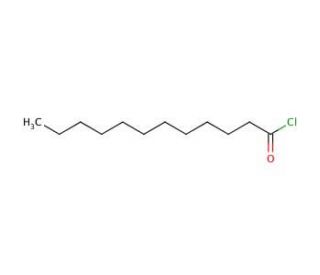

Dodecanoyl chloride (CAS 112-16-3)
QUICK LINKS
Dodecanoyl chloride, also known as lauroyl chloride, is an organic compound that has garnered significant interest in scientific research, particularly in the fields of organic chemistry and materials science. Researchers have extensively studied the mechanisms and applications of dodecanoyl chloride in various contexts. Dodecanoyl chloride is primarily used as a reactive intermediate in organic synthesis. Its acyl chloride functional group enables it to participate in numerous chemical reactions, including acylation, esterification, and amidation. This compound has been employed as a versatile reagent for the modification of organic molecules, such as alcohols, amines, and carboxylic acids, to generate a wide range of products with tailored properties. In addition, dodecanoyl chloride has been utilized in the synthesis of specialty polymers, surfactants, and pharmaceutical intermediates. Its reactivity and ability to introduce specific functional groups make it a valuable tool for designing and synthesizing new materials. Furthermore, researchers have explored the use of dodecanoyl chloride as a surface modifier in materials science. By attaching dodecanoyl chloride to surfaces, it can alter the surface properties, such as wettability and adhesion, leading to applications in coatings, membranes, and bioactive surfaces. The research applications of dodecanoyl chloride contribute to advancements in organic synthesis, materials science, and the development of functional compounds with tailored properties and applications.
Dodecanoyl chloride (CAS 112-16-3) References
- Surface esterification of cellulose fibers: characterization by DRIFT and contact angle measurements. | Pasquini, D., et al. 2006. J Colloid Interface Sci. 295: 79-83. PMID: 16125715
- An easy synthetic approach to pyridoporphyrins by domino reactions. | Alonso, CM., et al. 2007. Org Lett. 9: 2305-8. PMID: 17506574
- Long-alkane-chain modified N-phthaloyl chitosan membranes with controlled permeability. | Chen, C., et al. 2013. Carbohydr Polym. 91: 269-76. PMID: 23044132
- [Preparation of a new stationary phase with s-triazine and amide embedded and its application in separation of basic compounds]. | Shen, C., et al. 2013. Se Pu. 31: 1035-9. PMID: 24558836
- Aliphatic chains grafted cellulose nanocrystals with core-corona structures for efficient toughening of PLA composites. | Niu, W., et al. 2022. Carbohydr Polym. 285: 119200. PMID: 35287842
- The Influence of Newly Synthesized Demulsifiers on the Interfacial Rheological Properties of a Naturally Occurring Water/Oil Emulsion. | Elsharaky, EA., et al. 2022. ACS Omega. 7: 32471-32480. PMID: 36119982
- Asymmetric Synthesis of Contact Sex Pheromone of Tetropium fuscum and Its Enantiomer. | Wang, X., et al. 2022. Molecules. 27: PMID: 36296492
- Serine-/Cysteine-Based sp2-Iminoglycolipids as Novel TLR4 Agonists: Evaluation of Their Adjuvancy and Immunotherapeutic Properties in a Murine Model of Asthma. | González-Cuesta, M., et al. 2023. J Med Chem. 66: 4768-4783. PMID: 36958376
- New ferrocene integrated amphiphilic guanidines: Synthesis, spectroscopic elucidation, DFT calculation and in vitro α-amylase and α-glucosidase inhibition combined with molecular docking approach. | Zubair, S., et al. 2023. Heliyon. 9: e14919. PMID: 37064477
- Performance of new synthesized emulsifiers in ecofriendly metal cutting fluid formulations. | Elsharaky, EA., et al. 2024. Sci Rep. 14: 5299. PMID: 38438426
Ordering Information
| Product Name | Catalog # | UNIT | Price | Qty | FAVORITES | |
Dodecanoyl chloride, 250 ml | sc-214948 | 250 ml | $120.00 |