
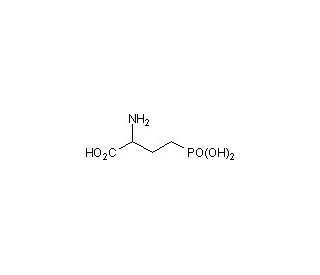

DL-2-Amino-4-phosphonobutanoic acid (AP4) (CAS 20263-07-4)
QUICK LINKS
DL-2-Amino-4-phosphonobutanoic acid (AP4) is extensively used in neuroscience research to explore the function and regulation of glutamate receptors, particularly in the context of synaptic transmission. It acts as a potent and selective agonist for group III metabotropic glutamate receptors, which are critical for understanding neurotransmitter systems in the brain. Research involving DL-2-Amino-4-phosphonobutanoic acid (AP4) often focuses on its effects on excitatory and inhibitory balance within neural circuits, which is fundamental for investigating mechanisms underlying various brain functions and behaviors. This compound is also instrumental in studies related to neuroplasticity and memory formation, where modulation of glutamate receptors plays a pivotal role.
DL-2-Amino-4-phosphonobutanoic acid (AP4) (CAS 20263-07-4) References
- Development of antibodies for the detection of N-acetyl-glufosinate. | Weller, MG., et al. 2003. J Agric Food Chem. 51: 6668-75. PMID: 14582958
- Evidence that L-AP5 and D,L-AP4 can preferentially block cone signals in the rat retina. | Green, DG. and Kapousta-Bruneau, NV. 2007. Vis Neurosci. 24: 9-15. PMID: 17430605
- Structural, conformational, and stereochemical requirements of central excitatory amino acid receptors. | Hansen, JJ. and Krogsgaard-Larsen, P. 1990. Med Res Rev. 10: 55-94. PMID: 2153264
- Excitatory amino acid receptors in the vertebrate central nervous system. | Collingridge, GL. and Lester, RA. 1989. Pharmacol Rev. 41: 143-210. PMID: 2558391
- An explanation for the purported excitation of piriform cortical neurons by N-acetyl-L-aspartyl-L-glutamic acid (NAAG). | Whittemore, ER. and Koerner, JF. 1989. Proc Natl Acad Sci U S A. 86: 9602-5. PMID: 2574464
- Preliminary pharmacological investigation on 38 aminophosphonic acids and their derivatives. | Kleinrok, Z., et al. 1985. Pol J Pharmacol Pharm. 37: 575-84. PMID: 3008130
- Antagonism of excitatory amino acid-induced responses and of synaptic excitation in the isolated spinal cord of the frog. | Evans, RH., et al. 1979. Br J Pharmacol. 67: 591-603. PMID: 316343
- Actions of D and L forms of 2-amino-5-phosphonovalerate and 2-amino-4-phosphonobutyrate in the cat spinal cord. | Davies, J. and Watkins, JC. 1982. Brain Res. 235: 378-86. PMID: 6145492
- 2-amino-4-phosphonobutyric acid: a new pharmacological tool for retina research. | Slaughter, MM. and Miller, RF. 1981. Science. 211: 182-5. PMID: 6255566
- Micromolar L-2-amino-4-phosphonobutyric acid selectively inhibits perforant path synapses from lateral entorhinal cortex. | Koerner, JF. and Cotman, CW. 1981. Brain Res. 216: 192-8. PMID: 6266585
- The effects of a series of omega-phosphonic alpha-carboxylic amino acids on electrically evoked and excitant amino acid-induced responses in isolated spinal cord preparations. | Evans, RH., et al. 1982. Br J Pharmacol. 75: 65-75. PMID: 7042024
Ordering Information
| Product Name | Catalog # | UNIT | Price | Qty | FAVORITES | |
DL-2-Amino-4-phosphonobutanoic acid (AP4), 50 mg | sc-200430 | 50 mg | $34.00 | |||
DL-2-Amino-4-phosphonobutanoic acid (AP4), 100 mg | sc-200430A | 100 mg | $67.00 |