
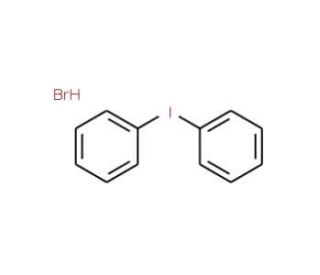

Diphenyliodonium bromide 의 분자 구조, CAS 번호: 1483-73-4
Diphenyliodonium bromide (CAS 1483-73-4)
CAS 등록번호:
1483-73-4
분자량:
361.02
분자식:
C12H10BrI
추가 정보:
운송용 위험물로 분류되어 추가 배송료가 부과될 수 있습니다.
연구용으로만 사용가능합니다. 진단이나 치료용으로 사용불가합니다.
* 참조분석증명서대량의 측정 데이터(함수량포함).
빠른 링크
주문정보
설명
기술정보
안전정보
SDS 및 분석 증명서
브로민화 디페닐리오도늄염은 유기화합물의 합성 시약으로서 유기합성에 널리 이용되고 있는 유기요오도늄염으로서, 과학적인 연구에서 촉매로서, 산화제로서도 이용되고 있다. 브로민화 디페닐리오도늄염은 요오도늄 양이온과 브로민화 음이온으로 이루어진 화학구조 때문에 요오도늄염으로서 과학적인 연구에서 광범위하게 이용되고 있다. 이는 유기화합물의 합성, 촉매 및 산화제의 제조, 생화학적 및 생리적 효과의 연구 등에 이용되고 있다. 브로민화 디페닐리오도늄염은 의약품, 살충제 및 염료를 포함한 각종 유기화합물의 합성에 이용되고 있다. 또한 유기합성의 촉매 및 산화제의 제조에도 이용되고 있다. 또한 브로민화 디페닐리오도늄염은 다양한 화합물 및 약물의 생화학적 및 생리적 효과를 연구하는 데 이용되고 있다. 브로민화 디페닐리오도늄염의 작용기전에 대해서는 잘 알려져 있지 않지만, 브로민화 음이온과 요오도늄 양이온의 공유결합의 형성에 관여하는 것으로 알려져 있으며, 이는 이들의 촉매적 특성 및 산화적 특성을 담당한다.
Diphenyliodonium bromide (CAS 1483-73-4) 참고자료
- 아릴리오도늄 염을 이용한 N-아릴프로피올아미드의 팔라듐 촉매 C-H 기능화: 3-(1-아릴메틸렌)옥신돌의 선택적 합성. | Tang, S., et al. 2008. J Org Chem. 73: 5476-80. PMID: 18557647
- 디아릴리오도늄염: 무명에서 명성으로의 여정. | Merritt, EA. and Olofsson, B. 2009. Angew Chem Int Ed Engl. 48: 9052-70. PMID: 19876992
- 아데노바이러스 막 침투는 NLRP3 인플라마좀을 활성화합니다. | Barlan, AU., et al. 2011. J Virol. 85: 146-55. PMID: 20980503
- 폴리염화 디페닐 에테르의 합성, 구조 검증 및 크로마토그래피 상대 체류 시간. | Nevalainen, T., et al. 1994. Environ Sci Technol. 28: 1341-7. PMID: 22176328
- 염기 및 금속이 없는 나프탈렌 및 기타 편향되지 않은 아렌과 디아릴리오도늄 염의 C-H 직접 아릴화. | Castro, S., et al. 2012. Chem Commun (Camb). 48: 9089-91. PMID: 22854914
- N-아릴록시이미드와 아릴록시아민의 무금속 합성. | Ghosh, R. and Olofsson, B. 2014. Org Lett. 16: 1830-2. PMID: 24597780
- 템포나를 이용한 고가 요오드(III) 화합물의 환원을 통한 아릴 라디칼 생성: 라디칼 알켄 옥시아릴레이션. | Hartmann, M., et al. 2016. Chemistry. 22: 3485-3490. PMID: 26834017
- 양이온 중합: 광개시에서 광제어까지. | Michaudel, Q., et al. 2017. Angew Chem Int Ed Engl. 56: 9670-9679. PMID: 28277625
- 물에서 디아릴리오도늄 염을 활용한 금속이 없는 C-N 및 C-O 결합의 재선택적 형성: N-아릴퀴놀론 및 아릴옥시퀴놀린의 손쉬운 합성. | Mehra, MK., et al. 2017. Org Biomol Chem. 15: 4956-4961. PMID: 28567465
- PROAD에서 이니퍼터 공정으로의 기계적 변환을 통한 블록 공중합체. | Ciftci, M. and Yagci, Y. 2018. Macromol Rapid Commun. 39: e1800464. PMID: 30091815
- 팔라듐 촉매에 의한 C-H 활성화를 통한 나프탈렌의 C8-아릴화: 실험과 계산을 결합한 연구. | Garrec, J., et al. 2019. Chemistry. 25: 14441-14446. PMID: 31478579
- 요오드(III)-기반 할로겐 결합 기증자: 특성 및 응용. | Robidas, R., et al. 2021. Chem Rec. 21: 1912-1927. PMID: 34145711
- 살아있는 3D 프린팅을 향한 광유도 자유 라디칼 촉진 양이온성 RAFT 중합. | Zhao, B., et al. 2021. ACS Macro Lett. 10: 1315-1320. PMID: 35549049
- 디아릴리오도늄 화학물질이 성장하는 스티어에서 질소 이용에 미치는 영향. | Chalupa, W., et al. 1983. J Anim Sci. 57: 195-200. PMID: 6885660
주문정보
| 제품명 | 카탈로그 번호 | 단위 | 가격 | 수량 | 관심품목 | |
Diphenyliodonium bromide, 10 g | sc-268954 | 10 g | $159.00 |