
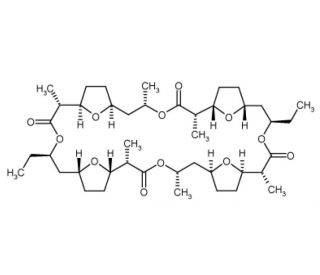

Dinactin (CAS 20261-85-2)
QUICK LINKS
Dinactin, with the CAS number 20261-85-2, is a naturally occurring macrocyclic compound that is part of a broader class of chemicals known as macrotetrolides. This compound is derived from certain strains of Streptomyces bacteria and is notable for its ability to form complexes with monovalent cations, particularly potassium ions. Dinactin functions primarily through its ionophoric activity, which involves the transportation of potassium ions across cellular membranes. This ion transport disrupts the normal ionic gradients that are crucial for various cellular functions, thereby affecting cellular processes such as membrane potential maintenance, nutrient uptake, and ion balance. In research settings, dinactin has been used extensively to study the mechanisms of ion transport across membranes and to explore the dynamics of cellular ion homeostasis. By altering potassium ion concentration within cells, researchers are able to investigate how cells regulate their internal environment and respond to changes in ion concentrations. Additionally, studies involving dinactin have provided insights into the structural features that facilitate ion transport in biological systems, contributing to a broader understanding of membrane transport phenomena and the role of ionophores in modulating biological processes at the cellular level.
Dinactin (CAS 20261-85-2) References
- Effects of cyclosporin A and dinactin on T-cell proliferation, interleukin-5 production, and murine pulmonary inflammation. | Umland, SP., et al. 1999. Am J Respir Cell Mol Biol. 20: 481-92. PMID: 10030847
- Streptomyces puniceus strain AS13., Production, characterization and evaluation of bioactive metabolites: A new face of dinactin as an antitumor antibiotic. | Hussain, A., et al. 2018. Microbiol Res. 207: 196-202. PMID: 29458855
- In vitro evaluation of dinactin, a potent microbial metabolite against Mycobacterium tuberculosis. | Hussain, A., et al. 2019. Int J Antimicrob Agents. 53: 49-53. PMID: 30267759
- Dinactin from a new producer, Streptomyces badius gz-8, and its antifungal activity against the rubber anthracnose fungus Colletotrichum gloeosporioides. | Zhang, K., et al. 2020. Microbiol Res. 240: 126548. PMID: 32653809
- Immunosuppressive effects of polynactins (tetranactin, trinactin and dinactin) on experimental autoimmune uveoretinitis in rats. | Tanouchi, Y. and Shichi, H. 1987. Jpn J Ophthalmol. 31: 218-29. PMID: 3499534
- Exploration of Diverse Secondary Metabolites From Streptomyces sp. YINM00001, Using Genome Mining and One Strain Many Compounds Approach. | Liu, T., et al. 2022. Front Microbiol. 13: 831174. PMID: 35222341
- Bio-priming with a consortium of Streptomyces araujoniae strains modulates defense response in chickpea against Fusarium wilt. | Zeyad, MT., et al. 2022. Front Microbiol. 13: 998546. PMID: 36160196
- Dinactin: A New Antitumor Antibiotic with Cell Cycle Progression and Cancer Stemness Inhibiting Activities in Lung Cancer. | Rawangkan, A., et al. 2022. Antibiotics (Basel). 11: PMID: 36551502
- Natural Products from Singapore Soil-Derived Streptomycetaceae Family and Evaluation of Their Biological Activities. | Chin, EJ., et al. 2023. Molecules. 28: PMID: 37570802
- Antibiotics as tools for metabolic studies. VI. Damped oscillatory swelling of mitochondria induced by nonactin, monactin, dinactin, and trinactin. | Graven, SN., et al. 1966. Biochemistry. 5: 1735-42. PMID: 5962273
Ordering Information
| Product Name | Catalog # | UNIT | Price | Qty | FAVORITES | |
Dinactin, 1 mg | sc-202141 | 1 mg | $444.00 |