
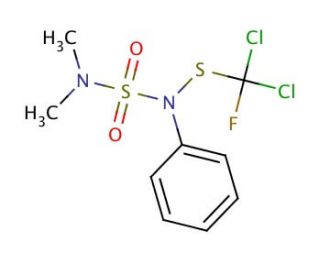

Molecular structure of Dichlofluanid, CAS Number: 1085-98-9
Dichlofluanid (CAS 1085-98-9)
CAS Number:
1085-98-9
Molecular Weight:
333.23
Molecular Formula:
C9H11Cl2FN2O2S2
Supplemental Information:
This is classified as a Dangerous Good for transport and may be subject to additional shipping charges.
For Research Use Only. Not Intended for Diagnostic or Therapeutic Use.
* Refer to Certificate of Analysis for lot specific data.
QUICK LINKS
Ordering Information
Description
Technical Information
Safety Information
SDS & Certificate of Analysis
Dichlofluanid, a widely employed fungicide, serves as an effective tool for managing various fungal diseases in plants. Belonging to the sulfamide class, dichlofluanid exhibits unique structural characteristics. It is a sulfamide compound with methyl groups replacing the hydrogen atoms on one nitrogen atom, while the other nitrogen atom is substituted with a phenyl group and a [dichloro(fluoro)methyl]sulfanediyl group. It falls under the category of sulfamides, being classified as an organofluorine and organochlorine compound. Its structure originates from a sulfamide precursor.
Dichlofluanid (CAS 1085-98-9) References
- Yeasts as a model for assessing the toxicity of the fungicides Penconazol, Cymoxanil and Dichlofluanid. | Ribeiro, IC., et al. 2000. Chemosphere. 41: 1637-42. PMID: 11057691
- Oxidative damages in isolated rat hepatocytes treated with the organochlorine fungicides captan, dichlofluanid and chlorothalonil. | Suzuki, T., et al. 2004. Toxicology. 204: 97-107. PMID: 15388237
- Variation in concentrations of the fungicides tebuconazole and dichlofluanid following successive applications to greenhouse-grown lettuces. | Rial-Otero, R., et al. 2005. J Agric Food Chem. 53: 4471-5. PMID: 15913313
- Monitoring of the booster biocide dichlofluanid in water and marine sediment of Greek marinas. | Hamwijk, C., et al. 2005. Chemosphere. 60: 1316-24. PMID: 16018903
- Fate and distribution of pyrimethanil, metalaxyl, dichlofluanid and penconazol fungicides from treated grapes intended for winemaking. | Vaquero-Fernández, L., et al. 2009. Food Addit Contam Part A Chem Anal Control Expo Risk Assess. 26: 164-71. PMID: 19680886
- Genotoxicity of the fungicide dichlofluanid in seven assays. | Heil, J., et al. 1991. Environ Mol Mutagen. 17: 20-6. PMID: 1991455
- Risks of using antifouling biocides in aquaculture. | Guardiola, FA., et al. 2012. Int J Mol Sci. 13: 1541-1560. PMID: 22408407
- Increase in intracellular Ca(2+) level by phenylsulfamide fungicides, tolylfluanid and dichlofluanid, in rat thymic lymphocytes. | Fukunaga, E., et al. 2015. Environ Toxicol Pharmacol. 40: 149-55. PMID: 26119233
- Rapid Determination of Dichlofluanid Residues in Vegetables Using Dispersive-SPE Sample Preparation Combined with Gas Chromatography-Mass Spectrometry. | Zhou, X., et al. 2016. J Chromatogr Sci. 54: 858-63. PMID: 26921896
- Mutagenic evaluation of the pesticides captan, folpet, captafol, dichlofluanid and related compounds with the mutants TA102 and TA104 of Salmonella typhimurium. | Barrueco, C. and de la Peña, E. 1988. Mutagenesis. 3: 467-80. PMID: 3070285
- Antifouling biocide dichlofluanid modulates the antioxidant defense system of the brown mussel Perna perna. | Rola, RC., et al. 2020. Mar Pollut Bull. 157: 111321. PMID: 32658686
- Abiotic fate of tolylfluanid and dichlofluanid in natural waters. | Cai, Y., et al. 2021. Sci Total Environ. 752: 142160. PMID: 33207498
- Acute and mutigenerational effects of environmental concentration of the antifouling agent dichlofluanid on the mysid model, Neomysis awatschensis. | Lee, S., et al. 2022. Environ Pollut. 311: 119996. PMID: 35988677
Ordering Information
| Product Name | Catalog # | UNIT | Price | Qty | FAVORITES | |
Dichlofluanid, 250 mg | sc-239695 | 250 mg | $59.00 |