
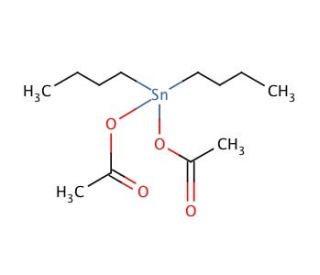

Dibutyltin diacetate 의 분자 구조, CAS 번호: 1067-33-0
Dibutyltin diacetate (CAS 1067-33-0)
적용:
Dibutyltin diacetate 은 응축 반응의 촉매입니다.
CAS 등록번호:
1067-33-0
분자량:
351.03
분자식:
C12H24O4Sn
추가 정보:
운송용 위험물로 분류되어 추가 배송료가 부과될 수 있습니다.
연구용으로만 사용가능합니다. 진단이나 치료용으로 사용불가합니다.
* Refer to Certificate of Analysis for lot specific data.
빠른 링크
주문정보
설명
기술정보
안전정보
SDS 및 분석 증명서
디부틸틴 디아세테이트는 유기 합성에서 에스테르화 및 에스테르 교환 반응을 촉진하는 촉매입니다. 카르복실산과 알코올의 카르보닐 산소와 결합하여 아실 중간체의 형성을 촉진하는 작용을 합니다. 이 결합은 카르보닐기를 활성화하여 알코올에 의한 핵친화적 공격에 더 취약하게 만듭니다. 그 결과 사면체 중간체가 붕괴되어 에스테르 생성물이 형성됩니다. 디부틸틴 디아세테이트는 아실 중간체의 형성을 촉진하고 전이 상태를 안정화하여 에스테르 형성 속도를 증가시켜 반응을 촉진하는 역할을 합니다. 이 물질의 작용 방식은 주석 원자와 카르보닐 산소의 배위를 조정하여 카르보닐 탄소의 친전성을 향상시켜 궁극적으로 원하는 에스테르 생성물을 유도합니다.
Dibutyltin diacetate (CAS 1067-33-0) 참고자료
- 발암 가능성에 대한 디부틸틴 디아세테이트의 생물학적 분석(CAS 번호 1067-33-0). | ,. 1979. Natl Toxicol Program Tech Rep Ser. 183: 1-107. PMID: 12778195
- 초임계 CO2에서 디부틸틴 디아세테이트와 딜라우레이트에 대한 분광학 및 이론적 결합 연구. | Renault, B., et al. 2008. J Phys Chem A. 112: 8379-86. PMID: 18707063
- 표면 활성 폴리머를 포함하는 주석 및 비스무트 촉매 PDMS 기반 코팅에 대한 생태독성학적 연구. | Pretti, C., et al. 2013. Ecotoxicol Environ Saf. 98: 250-6. PMID: 24125869
- 천연 고무 나노 복합재: 검토. | Bokobza, L. 2018. Nanomaterials (Basel). 9: PMID: 30583554
- RISK21 접근법을 사용하여 계층적 위험 평가를 위한 독성 시험 및 노출 평가에 새로운 접근 방법론을 통합합니다: 식품 접촉 화학물질에 대한 사례 연구. | Turley, AE., et al. 2019. Food Chem Toxicol. 134: 110819. PMID: 31545997
- 하이브리드 실리카-피틱산 코팅: 면의 열 안정성 및 난연성에 미치는 영향. | Barbalini, M., et al. 2019. Polymers (Basel). 11: PMID: 31614810
- 열경화성 수지의 제조에서 클릭형 반응의 사용. | Konuray, O., et al. 2020. Polymers (Basel). 12: PMID: 32397509
- 오르가노틴 디카르복실레이트를 이용한 우레탄 형성 촉매에 대한 연구. | Devendra, R., et al. 2020. Heliyon. 6: e04074. PMID: 32490256
- 호스트-게스트 상호작용을 통해 연결된 자가 치유 열가소성 폴리우레탄. | Jin, C., et al. 2020. Polymers (Basel). 12: PMID: 32580305
- 고에너지 소재를 위한 Al/HTPB 복합체의 제조 및 특성화. | Vorozhtsov, A., et al. 2020. Nanomaterials (Basel). 10: PMID: 33171684
- 건물 일체형 태양광(BIPV) 애플리케이션을 위한 염료 감응형 태양전지. | Szindler, M., et al. 2021. Materials (Basel). 14: PMID: 34279313
- 실리콘 엘라스토머와 이온성 액체 접목 실리콘 오일을 혼합하여 고감도 유연 압력 센서를 구현했습니다. | Kang, Z., et al. 2021. Front Robot AI. 8: 737500. PMID: 34616775
- 주석(II) 아세틸아세토네이트와 물을 이용한 SnO2 박막의 대기 원자층 증착. | Nguyen, VH., et al. 2022. Dalton Trans. 51: 9278-9290. PMID: 35670303
주문정보
| 제품명 | 카탈로그 번호 | 단위 | 가격 | 수량 | 관심품목 | |
Dibutyltin diacetate, 50 ml | sc-223935 | 50 ml | $61.00 | |||
Dibutyltin diacetate, 250 ml | sc-223935A | 250 ml | $184.00 |