
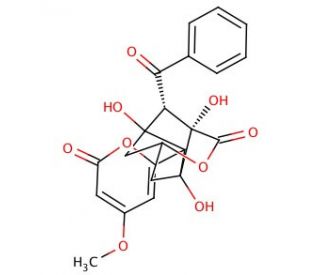

Deoxyenterocin (CAS 108605-51-2)
QUICK LINKS
Deoxyenterocin is a polyether antibiotic known for its potent ionophoric properties, which disrupt cellular ion gradients by facilitating the transport of ions across lipid membranes. Its mechanism of action involves forming complexes with monovalent cations such as sodium and potassium, effectively shuttling them across the cellular membranes. This ion transport disrupts the ion balance within cells, leading to cell membrane depolarization and disruption of essential cellular processes such as ATP synthesis and nutrient transport. In research, deoxyenterocin is extensively used to study membrane biology and ion transport mechanisms. Its ability to alter membrane potential makes it a valuable tool for investigating the physiological roles of ion gradients in various cellular functions, including signal transduction, energy production, and cell volume regulation. Researchers utilize deoxyenterocin to explore how disruptions in ion homeostasis affect cell viability and to model conditions of ion imbalance in experimental systems. Moreover, deoxyenterocin′s ionophoric activity is exploited in studies aimed at developing new antimicrobial agents. By understanding the specific interactions between deoxyenterocin and microbial cell membranes, researchers can design novel compounds that mimic its ionophoric action to combat resistant bacterial strains. Additionally, deoxyenterocin is used in biophysical studies to explain the structure-function relationships of ionophores and their role in modulating membrane dynamics. These research applications highlight the importance of deoxyenterocin in advancing our understanding of cellular ion transport and its broader implications in microbiology and biochemistry.
Deoxyenterocin (CAS 108605-51-2) References
- In vitro biosynthesis of unnatural enterocin and wailupemycin polyketides. | Kalaitzis, JA., et al. 2009. J Nat Prod. 72: 469-72. PMID: 19215142
- Direct capture and heterologous expression of Salinispora natural product genes for the biosynthesis of enterocin. | Bonet, B., et al. 2015. J Nat Prod. 78: 539-42. PMID: 25382643
- Cell-free synthetic biology for in vitro biosynthesis of pharmaceutical natural products. | Li, J., et al. 2018. Synth Syst Biotechnol. 3: 83-89. PMID: 29900420
- Biomimetic Approach Toward Enterocin and Deoxyenterocin. | Rizzo, A., et al. 2019. J Org Chem. 84: 1162-1175. PMID: 30520624
- Antiviral potential of natural products from marine microbes. | Yi, M., et al. 2020. Eur J Med Chem. 207: 112790. PMID: 32937282
- Biomimetic Total Synthesis of Enterocin. | Koser, L., et al. 2021. Angew Chem Int Ed Engl. 60: 20269-20273. PMID: 34278701
- Activation of Secondary Metabolism in Red Soil-Derived Streptomycetes via Co-Culture with Mycolic Acid-Containing Bacteria. | Wang, K., et al. 2021. Microorganisms. 9: PMID: 34835313
- Expanding the Chemical Diversity of Secondary Metabolites Produced by Two Marine-Derived Enterocin- and Wailupemycin-Producing Streptomyces Strains. | Xia, K., et al. 2023. ACS Omega. 8: 28886-28897. PMID: 37576654
- Natural Product-Derived Phytochemicals for Influenza A Virus (H1N1) Prevention and Treatment. | Li, R., et al. 2024. Molecules. 29: PMID: 38792236
Ordering Information
| Product Name | Catalog # | UNIT | Price | Qty | FAVORITES | |
Deoxyenterocin, 1 mg | sc-362729 | 1 mg | $315.00 |