
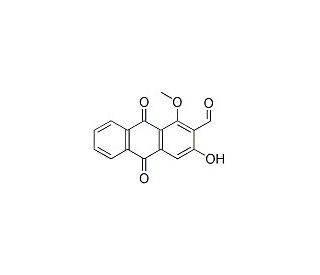

Molecular structure of Damnacanthal, CAS Number: 477-84-9
Damnacanthal (CAS 477-84-9)
See product citations (1)
Application:
Damnacanthal is an immunomodulator and potent inhibitor of p56lck tyrosine kinase
CAS Number:
477-84-9
Purity:
95%
Molecular Weight:
282.25
Molecular Formula:
C16H10O5
For Research Use Only. Not Intended for Diagnostic or Therapeutic Use.
* Refer to Certificate of Analysis for lot specific data.
QUICK LINKS
Ordering Information
Product Citations
Description
Technical Information
Safety Information
SDS & Certificate of Analysis
Damnacanthal, an anthraquinone isolated from roots of Morinda elliptica, has been reported as a selective and potent inhibitor of LcK (p56lck tyrosine kinase) activity. Mechanistic studies have shown Damnacanthal to be mixed noncompetitive with the ATP site, competitive with the peptide binding site, and bind nonspecifically to membrane lipids. Other studies have shown Damnacanthal to have immunomodulatory effects by activating mouse thymocytes and peripheral blood mononuclear cells (PBMC). In addition, Viral Protein R, a protein that contributes to apoptosis, multiple cytopathic effects, and G2 cell cycle arrest has been proven to be inhibited by Damnacanthal.
Damnacanthal (CAS 477-84-9) References
- Cell-based chemical genetic screen identifies damnacanthal as an inhibitor of HIV-1 Vpr induced cell death. | Kamata, M., et al. 2006. Biochem Biophys Res Commun. 348: 1101-6. PMID: 16904642
- Immunomodulatory effects of damnacanthal isolated from roots of Morinda elliptica. | Alitheen, NB., et al. 2010. Pharm Biol. 48: 446-52. PMID: 20645725
- Damnacanthal, a noni component, exhibits antitumorigenic activity in human colorectal cancer cells. | Nualsanit, T., et al. 2012. J Nutr Biochem. 23: 915-23. PMID: 21852088
- Damnacanthal-induced anti-inflammation is associated with inhibition of NF-κB activity. | Nualsanit, T., et al. 2011. Inflamm Allergy Drug Targets. 10: 455-63. PMID: 21999179
- Damnacanthal is a potent inducer of apoptosis with anticancer activity by stimulating p53 and p21 genes in MCF-7 breast cancer cells. | Aziz, MY., et al. 2014. Oncol Lett. 7: 1479-1484. PMID: 24765160
- Damnacanthal inhibits the NF-κB/RIP-2/caspase-1 signal pathway by inhibiting p56lck tyrosine kinase. | Kim, MH. and Jeong, HJ. 2014. Immunopharmacol Immunotoxicol. 36: 355-63. PMID: 25139491
- Damnacanthal inhibits IgE receptor-mediated activation of mast cells. | Garcia-Vilas, JA., et al. 2015. Mol Immunol. 65: 86-93. PMID: 25656801
- Damnacanthal and its nanoformulation exhibit anti-cancer activity via cyclin D1 down-regulation. | Sukamporn, P., et al. 2016. Life Sci. 152: 60-6. PMID: 27018445
- Antitumorigenic effect of damnacanthal on melanoma cell viability through p53 and NF-κB/caspase-3 signaling pathways. | Zhang, X., et al. 2018. Oncol Lett. 16: 6039-6044. PMID: 30333875
- Chitosan-based nanoparticles with damnacanthal suppress CRM1 expression. | Chaichanasak, N., et al. 2018. Oncol Lett. 16: 7029-7034. PMID: 30546436
- Development of biodegradable sustained-release damnacanthal nanocapsules for potential application in in-vitro breast cancer studies. | Mohd, MR., et al. 2019. Pak J Pharm Sci. 32: 2155-2162. PMID: 31813882
- Damnacanthal isolated from morinda species inhibited ovarian cancer cell proliferation and migration through activating autophagy. | Li, R., et al. 2022. Phytomedicine. 100: 154084. PMID: 35421676
- Damnacanthal is a highly potent, selective inhibitor of p56lck tyrosine kinase activity. | Faltynek, CR., et al. 1995. Biochemistry. 34: 12404-10. PMID: 7547985
Inhibitor of:
Apoptosis, and Lck.Ordering Information
| Product Name | Catalog # | UNIT | Price | Qty | FAVORITES | |
Damnacanthal, 1 mg | sc-200611 | 1 mg | $237.00 |