
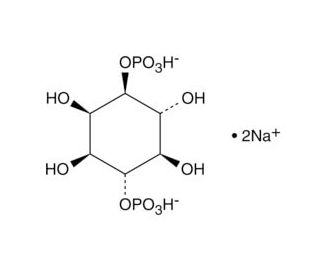

D-myo-Inositol-1,4-diphosphate, sodium salt
QUICK LINKS
D-myo-Inositol-1,4-diphosphate, sodium salt is involved in cellular signaling pathways as a secondary messenger. It plays a role in the regulation of various cellular processes, including cell growth, differentiation, and apoptosis. This compound interacts with specific receptors and enzymes within the cell, leading to the activation or inhibition of downstream signaling cascades. D-myo-Inositol-1,4-diphosphate, sodium salt modulates the activity of key proteins and kinases, influencing gene expression and cellular responses. The mode of action involves binding to specific targets and triggering a series of biochemical events that ultimately impact cellular function. D-myo-Inositol-1,4-diphosphate, is integral to the intricate network of signaling pathways that govern cellular behavior and is a key player in the regulation of various physiological processes.
D-myo-Inositol-1,4-diphosphate, sodium salt References
- Inositol phosphate biochemistry. | Majerus, PW. 1992. Annu Rev Biochem. 61: 225-50. PMID: 1323235
- Quantification of inositol phosphates in almond meal and almond brown skins by HPLC/ESI/MS. | Duong, QH., et al. 2017. Food Chem. 229: 84-92. PMID: 28372252
- Development of LC-MS-ESI-TOF method for quantification of phytates in food using 13C-labelled maize as internal standard. | Tanilas, K. and Kriščiunaite, T. 2022. Anal Bioanal Chem. 414: 1539-1552. PMID: 35024913
- Phytate and mineral profile evolutions to explain the textural hardening of common beans (Phaseolus vulgaris L.) during postharvest storage and soaking: Insights obtained through a texture-based classification approach. | Chen, D., et al. 2023. Food Chem. 404: 134531. PMID: 36228478
- Release of Ca2+ from a nonmitochondrial intracellular store in pancreatic acinar cells by inositol-1,4,5-trisphosphate. | Streb, H., et al. Nature. 306: 67-9. PMID: 6605482
- Inositol trisphosphate and calcium signalling. | Berridge, MJ. 1993. Nature. 361: 315-25. PMID: 8381210
- Regulation of phosphoinositide phospholipases by hormones, neurotransmitters, and other agonists linked to G proteins. | Exton, JH. 1996. Annu Rev Pharmacol Toxicol. 36: 481-509. PMID: 8725399
- Structure and function of inositol 1,4,5-trisphosphate receptor. | Yoshida, Y. and Imai, S. 1997. Jpn J Pharmacol. 74: 125-37. PMID: 9243320
- Determination of myo-inositol phosphates in tree nuts and grain fractions by HPLC–ESI–MS | Quynh H. Duong a, Kevin D. Clark a, Karen G. Lapsley b, Ronald B. Pegg a. 2017. Journal of Food Composition and Analysis. 59: 74-82.
Ordering Information
| Product Name | Catalog # | UNIT | Price | Qty | FAVORITES | |
D-myo-Inositol-1,4-diphosphate, sodium salt, 100 µg | sc-223924 | 100 µg | $67.00 | |||
D-myo-Inositol-1,4-diphosphate, sodium salt, 500 µg | sc-223924A | 500 µg | $359.00 |