
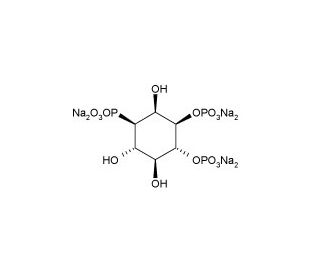

D-myo-Inositol 1,3,6-trisphosphate hexasodium salt
QUICK LINKS
D-myo-Inositol 1,3,6-trisphosphate hexasodium salt, also known as Ins(1,3,6)P3, is a key signaling molecule involved in intracellular calcium regulation and cellular processes. Its mechanism of action primarily revolves around its ability to bind to specific receptors on the endoplasmic reticulum (ER) membrane, leading to the release of calcium ions from intracellular stores into the cytoplasm. This calcium release triggers various downstream signaling cascades, modulating cellular activities such as muscle contraction, secretion, and gene expression. Ins(1,3,6)P3 is generated from phosphatidylinositol 4,5-bisphosphate (PIP2) via the action of phospholipase C (PLC) upon activation by extracellular signals. Once produced, Ins(1,3,6)P3 diffuses through the cytoplasm and binds to its receptors, called inositol trisphosphate receptors (IP3Rs), which are calcium channels on the ER membrane. Binding of Ins(1,3,6)P3 to IP3Rs induces conformational changes, leading to the opening of the channel pore and subsequent calcium release. This calcium release triggers downstream signaling events mediated by calcium-dependent proteins, influencing cellular physiology and function. In research, Ins(1,3,6)P3 is utilized to study calcium signaling pathways, investigate its role in cellular processes, and explain its implications in various physiological and pathological conditions. Researchers employ a range of techniques such as fluorescence imaging, electrophysiology, and biochemical assays to explore the dynamics of Ins(1,3,6)P3-mediated calcium signaling and its impact on cellular function and disease mechanisms.
D-myo-Inositol 1,3,6-trisphosphate hexasodium salt References
- Inositol 1,3,4-trisphosphate acts in vivo as a specific regulator of cellular signaling by inositol 3,4,5,6-tetrakisphosphate. | Yang, X., et al. 1999. J Biol Chem. 274: 18973-80. PMID: 10383396
Ordering Information
| Product Name | Catalog # | UNIT | Price | Qty | FAVORITES | |
D-myo-Inositol 1,3,6-trisphosphate hexasodium salt, 100 µg | sc-205939 | 100 µg | $130.00 | |||
D-myo-Inositol 1,3,6-trisphosphate hexasodium salt, 1 mg | sc-205939A | 1 mg | $825.00 |