
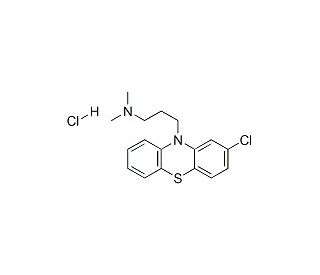

Chlorpromazine, Hydrochloride (CAS 69-09-0)
See product citations (7)
QUICK LINKS
Chlorpromazine, Hydrochloride (CPZ-HCl) is a phenothiazine-based compound that has been widely used to research various mental health disorders, including schizophrenia, bipolar disorder, and depression. It possesses potent antipsychotic, anxiolytic, and sedative properties and is also investigated for alleviating symptoms such as nausea, vomiting, and hiccups. Chlorpromazine, Hydrochloride acts as an inhibitor of calmodulin-dependent stimulation of cyclic nucleotide phosphodiesterase (PDE) and displays D2DR inhibition. Moreover, it exhibits α-adrenergic blocking action. Chlorpromazine, Hydrochloride is known to inhibit Eg5, Histamine H1 Receptor, NOS1, and PLA2. The biochemical and physiological effects of Chlorpromazine, Hydrochloride are diverse. It has been observed to inhibit the reuptake of dopamine and serotonin, monoamine oxidase, calcium channels, adenylate cyclase, and phosphodiesterases. Furthermore, it can influence the production of hormones such as prolactin, corticosterone, and thyroid hormones. The primary mode of action of Chlorpromazine, Hydrochloride involves the blockade of dopamine receptors in the brain, resulting in reduced dopamine transmission and diminished stimulation of postsynaptic neurons. Additionally, it affects serotonin receptors, leading to decreased serotonin transmission and lowered stimulation of postsynaptic neurons. Chlorpromazine, Hydrochloride also interacts with other neurotransmitter systems, including norepinephrine and acetylcholine, resulting in attenuated stimulation of postsynaptic neurons. With its extensive usage in scientific research, Chlorpromazine, Hydrochloride serves as useful for investigating cellular signaling pathways and neuroscience phenomena.
Chlorpromazine, Hydrochloride (CAS 69-09-0) References
- Toxicity and carcinogenicity studies of chlorpromazine hydrochloride and p-cresidine in the p53 heterozygous mouse model. | Petruska, JM., et al. 2002. Toxicol Pathol. 30: 696-704. PMID: 12512871
- Spectroelectrochemical determination of chlorpromazine hydrochloride by flow-injection analysis. | Daniel, D. and Gutz, IG. 2005. J Pharm Biomed Anal. 37: 281-6. PMID: 15708668
- The novel combination of chlorpromazine and pentamidine exerts synergistic antiproliferative effects through dual mitotic action. | Lee, MS., et al. 2007. Cancer Res. 67: 11359-67. PMID: 18056463
- Voltammetric determination of chlorpromazine hydrochloride. | Dermiş, S. and Biryol, I. 1989. Analyst. 114: 525-6. PMID: 2757225
- Ameliorative effect of chlorpromazine hydrochloride on visceral hypersensitivity in rats: possible involvement of 5-HT2A receptor. | Asano, T., et al. 2017. Br J Pharmacol. 174: 3370-3381. PMID: 28750135
- Drug-protein interactions: binding of chlorpromazine to calmodulin, calmodulin fragments, and related calcium binding proteins. | Marshak, DR., et al. 1985. Biochemistry. 24: 144-50. PMID: 2986673
- [Chlorpromazine hydrochloride plays a tumor suppressive role in diffuse large B lymphoma by promoting the expression of S1PR2]. | Liang, Z., et al. 2021. Zhonghua Lao Dong Wei Sheng Zhi Ye Bing Za Zhi. 39: 418-423. PMID: 34218556
- A novel ratiometric electrochemical sensor based on dual-monomer molecularly imprinted polymer and Pt/Co3O4 for sensitive detection of chlorpromazine hydrochloride. | Liu, Y., et al. 2022. Anal Chim Acta. 1190: 339245. PMID: 34857150
- Metabolic profiling of lysophosphatidylcholines in chlorpromazine hydrochloride- and N-acetyl-p-amino-phenoltriptolide-induced liver injured rats based on ultra-performance liquid chromatography quadrupole time-of-flight mass spectrometry. | Hu, C., et al. 2022. Hum Exp Toxicol. 41: 9603271221108320. PMID: 35722787
- Potential therapeutic efficacy of inhibitors of human phospholipase A2 in septic shock. | Vadas, P., et al. 1986. Agents Actions. 19: 194-202. PMID: 3825740
- Macrophage uptake of oxidized LDL inhibits lysosomal sphingomyelinase, thus causing the accumulation of unesterified cholesterol-sphingomyelin-rich particles in the lysosomes. A possible role for 7-Ketocholesterol. | Maor, I., et al. 1995. Arterioscler Thromb Vasc Biol. 15: 1378-87. PMID: 7670952
- Chlorpromazine inhibits both the constitutive nitric oxide synthase and the induction of nitric oxide synthase after LPS challenge. | Palacios, M., et al. 1993. Biochem Biophys Res Commun. 196: 280-6. PMID: 7692850
- Pharmacologic inhibitors of tumor necrosis factor production exert differential effects in lethal endotoxemia and in infection with live microorganisms in mice. | Netea, MG., et al. 1995. J Infect Dis. 171: 393-9. PMID: 7844376
- Selective inhibition of group II phospholipase A2 by quercetin. | Lindahl, M. and Tagesson, C. 1993. Inflammation. 17: 573-82. PMID: 8225564
- Protective effect of calmodulin inhibitors against acute cyanide-induced lethality and convulsions in mice. | Yamamoto, H. 1993. Toxicol Lett. 66: 73-9. PMID: 8427023
Ordering Information
| Product Name | Catalog # | UNIT | Price | Qty | FAVORITES | |
Chlorpromazine, Hydrochloride, 500 mg | sc-202537 | 500 mg | $40.00 | |||
Chlorpromazine, Hydrochloride, 5 g | sc-202537A | 5 g | $56.00 | |||
Chlorpromazine, Hydrochloride, 25 g | sc-202537B | 25 g | $152.00 | |||
Chlorpromazine, Hydrochloride, 100 g | sc-202537C | 100 g | $506.00 | |||
Chlorpromazine, Hydrochloride, 250 g | sc-202537D | 250 g | $1109.00 |