
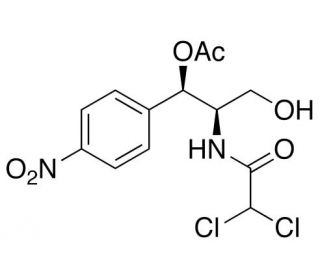

Molecular structure of Chloramphenicol 1-Acetate, CAS Number: 23214-93-9
Chloramphenicol 1-Acetate (CAS 23214-93-9)
Alternate Names:
N-[(1R,2R)-2-(Acetyloxy)-1-(hydroxymethyl)-2-(4-nitrophenyl)ethyl]-2,2-dichloro-acetamide; 1-Acetoxychloramphenicol; 1-Acetylchloramphenicol
CAS Number:
23214-93-9
Molecular Weight:
365.17
Molecular Formula:
C13H14Cl2N2O6
For Research Use Only. Not Intended for Diagnostic or Therapeutic Use.
* Refer to Certificate of Analysis for lot specific data.
QUICK LINKS
Ordering Information
Description
Technical Information
Safety Information
SDS & Certificate of Analysis
Chloramphenicol 1-Acetate has been adopted to investigate bacterial mechanisms, particularly those concerning resistance. It plays a role in the exploration of gene expression and the development of novel compounds. The mode of action for Chloramphenicol 1-Acetate involves the inhibition of protein production in bacteria by attaching to the 50S ribosomal subunit, effectively blocking the formation of the protein synthesis initiation complex and thereby impeding bacterial proliferation and survival.
Chloramphenicol 1-Acetate (CAS 23214-93-9) References
- Fertilization of cultured Xenopus oocytes and use in studies of maternally inherited molecules. | Heasman, J., et al. 1991. Methods Cell Biol. 36: 213-30. PMID: 1811135
- Regioselective Acetylation of C21 Hydroxysteroids by the Bacterial Chloramphenicol Acetyltransferase I. | Mosa, A., et al. 2015. Chembiochem. 16: 1670-9. PMID: 25999128
- Enhanced expression of the bacterial chloramphenicol acetyltransferase gene in mouse cells cotransfected with synthetic polynucleotides able to form Z-DNA. | Banerjee, R. and Grunberger, D. 1986. Proc Natl Acad Sci U S A. 83: 4988-92. PMID: 3014524
- Promiscuous trans activation of gene expression by an Epstein-Barr virus-encoded early nuclear protein. | Lieberman, PM., et al. 1986. J Virol. 60: 140-8. PMID: 3018281
- The glucocorticoid receptor recognizes a specific nucleotide sequence in hepatitis B virus DNA causing increased activity of the HBV enhancer. | Tur-Kaspa, R., et al. 1988. Virology. 167: 630-3. PMID: 3201757
- Lens-specific expression of the chloramphenicol acetyltransferase gene promoted by 5' flanking sequences of the murine alpha A-crystallin gene in explanted chicken lens epithelia. | Chepelinsky, AB., et al. 1985. Proc Natl Acad Sci U S A. 82: 2334-8. PMID: 3857584
- Characterization of chloramphenicol acetyltransferase from chloramphenicol-resistant Staphylococcus aureus. | Shaw, WV. and Brodsky, RF. 1968. J Bacteriol. 95: 28-36. PMID: 4965980
- Microbial transformation of antibiotics. VI. Acylation of chloramphenicol by Streptomyces coelicolor. | Argoudelis, AD. and Coats, JH. 1971. J Antibiot (Tokyo). 24: 206-8. PMID: 5551377
- A study of the enzymatic inactivation of chloramphenicol by highly purified chloramphenicol acetyltransferase. | Thibault, G., et al. 1980. Biochim Biophys Acta. 614: 339-42. PMID: 6996733
- Expression of a plant viral polycistronic mRNA in yeast, Saccharomyces cerevisiae, mediated by a plant virus translational transactivator. | Sha, Y., et al. 1995. Proc Natl Acad Sci U S A. 92: 8911-5. PMID: 7568042
- Biotransformation of antibiotics. I. Acylation of chloramphenicol by spores of Streptomyces griseus isolated from the Egyptian soil . | El-Kersh, TA. and Plourde, JR. 1976. J Antibiot (Tokyo). 29: 292-302. PMID: 816764
- Distribution of chloramphenicol acetyltransferase and chloramphenicol-3-acetate esterase among Streptomyces and Corynebacterium. | Nakano, H., et al. 1977. J Antibiot (Tokyo). 30: 76-82. PMID: 838634
- Mutations in the core promoter/enhancer II regions of naturally occurring hepatitis B virus variants and analysis of the effects on transcription activities. | Nishizono, A., et al. 1995. Intervirology. 38: 290-4. PMID: 8724860
Ordering Information
| Product Name | Catalog # | UNIT | Price | Qty | FAVORITES | |
Chloramphenicol 1-Acetate, 2.5 mg | sc-504799 | 2.5 mg | $380.00 |