
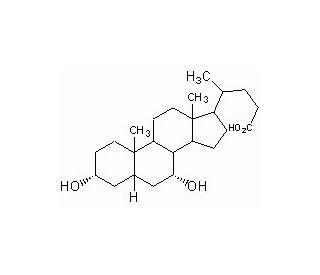

Chenodeoxycholic acid, free acid (CAS 474-25-9)
ENLACES RÁPIDOS
Chenodeoxycholic Acid, Free Acid y su isómero 7beta-ursodeoxycholic acid (sc-204935) son potentes inhibidores selectivos (afinidad nanomolar) de DD2 (AKR1C2). Estos compuestos son inhibidores no competitivos de AKR1D1 con valores Ki de 3.2 μM para chenodeoxycholic acid. Esta sustancia química es un ácido biliar primario hidrofóbico, que aumenta el Ca2+ intracelular en parejas de hepatocitos de ratón. Estudios indican que Chenodeoxycholic acid induce apoptosis a través de una vía dependiente de PKC. Se sabe que Chenodeoxycholic acid es esencial en el metabolismo del colesterol a través de la activación de receptores nucleares. Este ácido biliar también puede unirse a BABP con una estequiometría de 1:2. Estudios alternativos indican que chenodeoxycholic acid puede inhibir la expresión de IL-6 y la viabilidad celular en células QBC939.
Chenodeoxycholic acid, free acid (CAS 474-25-9) Referencias
- Aumento de la formación de ácido ursodesoxicólico en pacientes tratados con ácido quenodesoxicólico. | Salen, G., et al. 1974. J Clin Invest. 53: 612-21. PMID: 11344576
- Los ácidos biliares modulan el metabolismo de los glucocorticoides y el eje hipotalámico-hipofisario-suprarrenal en la ictericia obstructiva. | McNeilly, AD., et al. 2010. J Hepatol. 52: 705-11. PMID: 20347173
- [Efectos de los ácidos biliares sobre la expresión de interleucina-6 y la viabilidad celular en la línea celular QBC939]. | Wang, J., et al. 2010. Zhonghua Wai Ke Za Zhi. 48: 919-23. PMID: 21055228
- Conversión del ácido quenodesoxicólico en ácido cólico por el CYP8B1 humano. | Fan, L., et al. 2019. Biol Chem. 400: 625-628. PMID: 30465713
- Producción a gran escala de ácido ursodesoxicólico a partir de ácido quenodesoxicólico mediante ingeniería de 7α- y 7β-hidroxiesteroide deshidrogenasa. | Zhang, X., et al. 2019. Bioprocess Biosyst Eng. 42: 1537-1545. PMID: 31152232
- Desaturación de la bilis y disolución de cálculos biliares de colesterol con ácido quenodesoxicólico. | Hofmann, AF. 1977. Am J Clin Nutr. 30: 993-1000. PMID: 326024
- Patentes frente a pacientes 1-0: El caso del ácido quenodesoxicólico. | Briké, SM., et al. 2022. J Inherit Metab Dis. 45: 377-378. PMID: 34599614
- Tratamiento con ácido quenodesoxicólico de la protoporfiria eritrohepática. | Van Hattum, J., et al. 1986. J Hepatol. 3: 407-12. PMID: 3559148
- Síntesis de ácidos biliares. Metabolismo del ácido 3 beta-hidroxi-5-colenoico en ácido quenodesoxicólico. | Javitt, NB., et al. 1986. J Biol Chem. 261: 12486-9. PMID: 3745201
- La gallina de los huevos de oro: disolución de cálculos biliares en el hombre con ácido quenodesoxicólico. | Dowling, RH. 1974. Ir J Med Sci. 0: suppl:115-27. PMID: 4212419
- Transformación del ácido quenodesoxicólico y del ácido ursodesoxicólico por bacterias intestinales humanas. | Fedorowski, T., et al. 1979. Gastroenterology. 77: 1068-73. PMID: 488633
- Formación de ácido ursodesoxicólico a partir de ácido quenodesoxicólico en el colon humano: estudios del papel del ácido 7-cetolitoxicólico como intermediario. | Fromm, H., et al. 1983. J Lipid Res. 24: 841-53. PMID: 6631218
- Administración de ácido quenodesoxicólico monitorizada mediante perfiles séricos de ácidos biliares: estudio dosis-respuesta. | Whiting, MJ., et al. 1983. Ann Clin Biochem. 20 (Pt 6): 336-40. PMID: 6651198
- Ácido quenodesoxicólico: revisión de sus propiedades farmacológicas y uso terapéutico. | Iser, JH. and Sali, A. 1981. Drugs. 21: 90-119. PMID: 7009140
Información sobre pedidos
| Nombre del producto | Número de catálogo | UNIDAD | Precio | CANTIDAD | Favoritos | |
Chenodeoxycholic acid, free acid, 1 g | sc-278835 | 1 g | $28.00 | |||
Chenodeoxycholic acid, free acid, 5 g | sc-278835A | 5 g | $117.00 |