
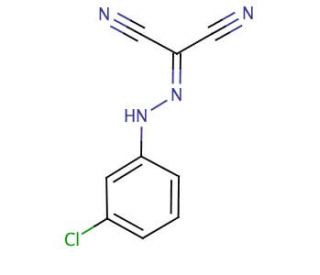

Carbonyl Cyanide m-Chlorophenylhydrazone (CAS 555-60-2)
See product citations (8)
QUICK LINKS
Carbonyl Cyanide m-Chlorophenylhydrazone (CCCP) is a versatile synthetic compound extensively utilized in scientific research. It exists as a colorless solid, soluble in polar organic solvents, and finds wide applications in synthetic organic chemistry and medicinal chemistry as an intermediate in drug synthesis. Carbonyl Cyanide m-Chlorophenylhydrazone exhibits various biochemical and physiological effects, including inhibiting enzymes involved in prostaglandin synthesis and cyclooxygenase activity. It has demonstrated anti-inflammatory, analgesic, and anti-tumor properties. Moreover, Carbonyl Cyanide m-Chlorophenylhydrazone has been employed in numerous scientific research applications, exploring its impact on drugs, cells, and tissues. While its mechanism of action is not fully understood, it is believed to hinder prostaglandin synthesis enzymes and competitively inhibit cyclooxygenase, for prostaglandin production. Additionally, Carbonyl Cyanide m-Chlorophenylhydrazone serves as a proton ionophore and is employed as an uncoupling agent and inhibitor of photosynthesis due to its effects on mitochondrial and chloroplast membranes. It acts as an inhibitor of ER-Golgi protein transport and has a high affinity for binding to Cytochrome C oxidase. In bullfrog sympathetic ganglia experiments, Carbonyl Cyanide m-Chlorophenylhydrazone increased the spontaneous release of luteinizing hormone-releasing hormone, with a strong dependence on firing frequency. Furthermore, studies suggest that Carbonyl Cyanide m-Chlorophenylhydrazone acts as a proton conductor, potentially influencing E. coli cell viability in the presence of glucose.
Carbonyl Cyanide m-Chlorophenylhydrazone (CAS 555-60-2) References
- Caffeine and carbonyl cyanide m-chlorophenylhydrazone increased evoked and spontaneous release of luteinizing hormone-releasing hormone from intact presynaptic terminals. | Cao, YJ. and Peng, YY. 1999. Neuroscience. 92: 1511-21. PMID: 10426503
- Caspase-3 activity and carbonyl cyanide m-chlorophenylhydrazone-induced apoptosis in HL-60. | Mlejnek, P. 2001. Altern Lab Anim. 29: 243-9. PMID: 11387021
- Carbonyl cyanide m-chlorophenylhydrazone induced calcium signaling and activation of plasma membrane H(+)-ATPase in the yeast Saccharomyces cerevisiae. | Pereira, MB., et al. 2008. FEMS Yeast Res. 8: 622-30. PMID: 18399987
- Mitochondrial uncoupler carbonyl cyanide M-chlorophenylhydrazone induces the multimer assembly and activity of repair enzyme protein L-isoaspartyl methyltransferase. | Fanélus, I. and Desrosiers, RR. 2013. J Mol Neurosci. 50: 411-23. PMID: 23319267
- Effect of carbonyl cyanide m-chlorophenylhydrazone on Escherichia coli halotolerance. | Ghoul, M., et al. 1989. Appl Environ Microbiol. 55: 1040-3. PMID: 2658803
- Mitochondrial uncoupler carbonyl cyanide m-chlorophenylhydrazone induces vasorelaxation without involving KATP channel activation in smooth muscle cells of arteries. | Zhang, YQ., et al. 2016. Br J Pharmacol. 173: 3145-3158. PMID: 27534899
- Effects of carbonyl cyanide m-chlorophenylhydrazone on quantal transmitter release and ultrastructure of frog motor nerve terminals. | Molgo, J. and Pecot-Dechavassine, M. 1988. Neuroscience. 24: 695-708. PMID: 2834667
- Maternal aging affects oocyte resilience to carbonyl cyanide-m-chlorophenylhydrazone -induced mitochondrial dysfunction in cows. | Kansaku, K., et al. 2017. PLoS One. 12: e0188099. PMID: 29182624
- The mitochondria-targeted derivative of the classical uncoupler of oxidative phosphorylation carbonyl cyanide m-chlorophenylhydrazone is an effective mitochondrial recoupler. | Iaubasarova, IR., et al. 2020. PLoS One. 15: e0244499. PMID: 33378414
- Effect of carbonyl cyanide m-chlorophenylhydrazone on respiration and respiration-dependent phosphorylation in Escherichia coli. | Cavari, BZ. and Avi-Dor, Y. 1967. Biochem J. 103: 601-8. PMID: 4962086
- Lethal effect of carbonyl cyanide m-chlorophenylhydrazone on Escherichia coli and a halotolerant Brevibacterium species. | Nagata, S. 1995. Microbios. 81: 73-83. PMID: 7476556
- Interaction of carbonyl cyanide 3-chlorophenylhydrazone with cytochrome c oxidase. | Bona, M., et al. 1993. Gen Physiol Biophys. 12: 533-42. PMID: 8070645
- Interaction of carbonyl cyanide m-chlorophenylhydrazone with the photosystem II acceptor side. | Samuilov, VD. and Barsky, EL. 1993. FEBS Lett. 320: 118-20. PMID: 8458426
- Effect of carbonyl cyanide m-chlorophenylhydrazone (CCCP) on the dimerization of lipoprotein lipase. | Park, JW., et al. 1997. Biochim Biophys Acta. 1344: 132-8. PMID: 9030190
Ordering Information
| Product Name | Catalog # | UNIT | Price | Qty | FAVORITES | |
Carbonyl Cyanide m-Chlorophenylhydrazone, 100 mg | sc-202984A | 100 mg | $77.00 | |||
Carbonyl Cyanide m-Chlorophenylhydrazone, 250 mg | sc-202984 | 250 mg | $153.00 | |||
Carbonyl Cyanide m-Chlorophenylhydrazone, 500 mg | sc-202984B | 500 mg | $240.00 |