
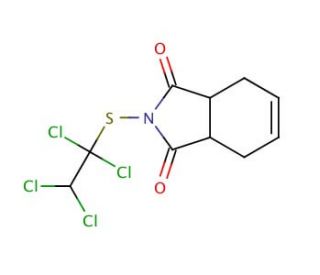

Captafol (CAS 2425-06-1)
QUICK LINKS
Captafol is a fungicide that functions by inhibiting the biosynthesis of methionine in fungi. It acts as a non-systemic protectant fungicide, forming a protective barrier on the surface of plant tissues to prevent fungal infection. Captafol works by disrupting the formation of the fungal cell wall, leading to the inhibition of mycelial growth and spore germination. Captafol′s mechanism of action involves interfering with the normal functioning of the fungal cells, ultimately leading to their death. Captafol′s mechanism of action targets specific enzymes involved in the biosynthesis of methionine, thereby interrupting the metabolic pathways critical for fungal growth and reproduction. Captafol′s role in experimental applications involves studying its impact on fungal development and exploring its potential as a fungicidal agent.
Captafol (CAS 2425-06-1) References
- Induction of rat liver cytochrome P450 isoenzymes CYP 1A and CYP 2B by different fungicides, nitrofurans, and quercetin. | Rahden-Staron, I., et al. 2001. Mutat Res. 498: 57-66. PMID: 11673071
- The inhibitory effect of the fungicides captan and captafol on eukaryotic topoisomerases in vitro and lack of recombinagenic activity in the wing spot test of Drosophila melanogaster. | Rahden-Staron, I. 2002. Mutat Res. 518: 205-13. PMID: 12113771
- [Determination of captafol, cyhexatin, 1-naphthylacetic acid and quintozene in apple, Japanese pear and melon by simultaneous extraction]. | Nagayama, T., et al. 2003. Shokuhin Eiseigaku Zasshi. 44: 126-31. PMID: 12846161
- Large volume cold on-column injection for gas chromatography-negative chemical ionization-mass spectrometry analysis of selected pesticides in air samples. | Bailey, R. and Belzer, W. 2007. J Agric Food Chem. 55: 1150-5. PMID: 17256963
- Analysis of captan, folpet, and captafol in apples by dispersive liquid-liquid microextraction combined with gas chromatography. | Zang, X., et al. 2008. Anal Bioanal Chem. 392: 749-54. PMID: 18665351
- Carcinogenicity of captafol in F344/DuCrj rats. | Tamano, S., et al. 1990. Jpn J Cancer Res. 81: 1222-31. PMID: 2125991
- Effects of Folpet, Captan, and Captafol on Human Aromatase in JEG-3 Cells. | Ge, H., et al. 2018. Pharmacology. 102: 81-87. PMID: 29953993
- Mutagenic evaluation of the pesticides captan, folpet, captafol, dichlofluanid and related compounds with the mutants TA102 and TA104 of Salmonella typhimurium. | Barrueco, C. and de la Peña, E. 1988. Mutagenesis. 3: 467-80. PMID: 3070285
- Improved analysis of captan, tetrahydrophthalimide, captafol, folpet, phthalimide, and iprodione in fruits and vegetables by liquid chromatography tandem mass spectrometry. | Oulkar, DP., et al. 2019. Food Chem. 301: 125216. PMID: 31404804
- Multi-residue analysis of captan, captafol, folpet, and iprodione in cereals using liquid chromatography with tandem mass spectrometry. | Shinde, R., et al. 2019. Food Addit Contam Part A Chem Anal Control Expo Risk Assess. 36: 1688-1695. PMID: 31535952
- Transformation of BALB/c 3T3 cells in vitro by the fungicides captan, captafol and folpet. | Perocco, P., et al. 1995. Jpn J Cancer Res. 86: 941-7. PMID: 7493913
- The effects of captan and captafol on different bacterial strains and on c-mitosis in V79 Chinese hamster fibroblasts. | Rahden-Staroń, I., et al. 1994. Acta Biochim Pol. 41: 45-55. PMID: 8030374
- Effect of fungicides, captafol and chlorothalonil, on microbial and enzymatic activities in mineral soil. | Tu, CM. 1993. J Environ Sci Health B. 28: 67-80. PMID: 8426061
- Evaluation of the carcinogenic potential of pesticides. 4. Chloroalkylthiodicarboximide compounds with fungicidal activity. | Quest, JA., et al. 1993. Regul Toxicol Pharmacol. 17: 19-34. PMID: 8441825
- Interaction of glutathione transferase P1-1 with captan and captafol. | di Ilio, C., et al. 1996. Biochem Pharmacol. 52: 43-8. PMID: 8678907
Ordering Information
| Product Name | Catalog # | UNIT | Price | Qty | FAVORITES | |
Captafol, 250 mg | sc-239476 | 250 mg | $21.00 |