
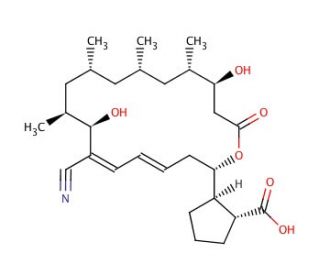

Borrelidin (CAS 7184-60-3)
See product citations (2)
QUICK LINKS
PAX9 inhibitors are a specialized class of chemical compounds designed to specifically target and inhibit the activity of the PAX9 protein, which stands for paired box 9. PAX9 is a transcription factor that belongs to the paired box (PAX) family of proteins, which play critical roles in regulating gene expression during embryonic development. This protein is essential for the development of various tissues and organs, including the formation of teeth, where it regulates the expression of genes involved in the growth and differentiation of dental tissues. By binding to specific DNA sequences, PAX9 influences the transcriptional activity of target genes, thereby orchestrating complex developmental processes. Structurally, PAX9 inhibitors can encompass a wide range of molecules, including small organic compounds, peptides, or larger biomolecules engineered to interact specifically with the DNA-binding domain or other functional regions of the PAX9 protein. These inhibitors typically function by blocking the ability of PAX9 to bind to its target DNA sequences, thereby preventing it from activating or repressing the transcription of its target genes. By inhibiting PAX9, these compounds can disrupt the regulatory networks controlled by this transcription factor, leading to alterations in the expression of genes critical for development. The study of PAX9 inhibitors is crucial for understanding the molecular mechanisms by which PAX9 regulates gene expression and the broader implications of its activity on developmental processes. Research into these inhibitors provides valuable insights into the role of transcription factors in cellular differentiation, tissue formation, and the maintenance of developmental programs. By exploring the effects of PAX9 inhibition, scientists can gain a deeper understanding of the intricate regulatory networks that govern development and the importance of precise gene regulation in maintaining proper tissue and organ formation.
Borrelidin (CAS 7184-60-3) References
- Borrelidin inhibits a cyclin-dependent kinase (CDK), Cdc28/Cln2, of Saccharomyces cerevisiae. | Tsuchiya, E., et al. 2001. J Antibiot (Tokyo). 54: 84-90. PMID: 11269718
- Borrelidin induces the transcription of amino acid biosynthetic enzymes via a GCN4-dependent pathway. | Eastwood, EL. and Schaus, SE. 2003. Bioorg Med Chem Lett. 13: 2235-7. PMID: 12798341
- Anti-angiogenesis effects of borrelidin are mediated through distinct pathways: threonyl-tRNA synthetase and caspases are independently involved in suppression of proliferation and induction of apoptosis in endothelial cells. | Kawamura, T., et al. 2003. J Antibiot (Tokyo). 56: 709-15. PMID: 14563161
- Biosynthesis of the angiogenesis inhibitor borrelidin by Streptomyces parvulus Tü4055: insights into nitrile formation. | Olano, C., et al. 2004. Mol Microbiol. 52: 1745-56. PMID: 15186422
- A unique hydrophobic cluster near the active site contributes to differences in borrelidin inhibition among threonyl-tRNA synthetases. | Ruan, B., et al. 2005. J Biol Chem. 280: 571-7. PMID: 15507440
- Isolation of borrelidin as a phytotoxic compound from a potato pathogenic streptomyces strain. | Cao, Z., et al. 2012. Biosci Biotechnol Biochem. 76: 353-7. PMID: 22313786
- Borrelidin modulates the alternative splicing of VEGF in favour of anti-angiogenic isoforms. | Woolard, J., et al. 2011. Chem Sci. 2011: 273-278. PMID: 22822423
- Insights into the preclinical treatment of blood-stage malaria by the antibiotic borrelidin. | Azcárate, IG., et al. 2013. Br J Pharmacol. 169: 645-58. PMID: 23488671
- Borrelidin has limited anti-cancer effects in bcl-2 overexpressing breast cancer and leukemia cells and reveals toxicity in non-malignant breast epithelial cells. | Gafiuc, D., et al. 2014. J Appl Toxicol. 34: 1109-13. PMID: 24155182
- Synthesis of complex intermediates for the study of a dehydratase from borrelidin biosynthesis. | Hahn, F., et al. 2014. Beilstein J Org Chem. 10: 634-640. PMID: 24778714
- Borrelidin Induces the Unfolded Protein Response in Oral Cancer Cells and Chop-Dependent Apoptosis. | Sidhu, A., et al. 2015. ACS Med Chem Lett. 6: 1122-7. PMID: 26617965
- Design, synthesis and antifungal evaluation of borrelidin derivatives. | Hu, C., et al. 2018. Bioorg Med Chem. 26: 6035-6049. PMID: 30442507
- Structural insights into dehydratase substrate selection for the borrelidin and fluvirucin polyketide synthases. | Barajas, JF., et al. 2019. J Ind Microbiol Biotechnol. 46: 1225-1235. PMID: 31115703
- A semisynthetic borrelidin analogue BN-3b exerts potent antifungal activity against Candida albicans through ROS-mediated oxidative damage. | Su, H., et al. 2020. Sci Rep. 10: 5081. PMID: 32193473
- Borrelidin is an angiogenesis inhibitor; disruption of angiogenic capillary vessels in a rat aorta matrix culture model. | Wakabayashi, T., et al. 1997. J Antibiot (Tokyo). 50: 671-6. PMID: 9315080
Ordering Information
| Product Name | Catalog # | UNIT | Price | Qty | FAVORITES | |
Borrelidin, 100 µg | sc-200379 | 100 µg | $96.00 | |||
Borrelidin, 1 mg | sc-200379A | 1 mg | $230.00 |