
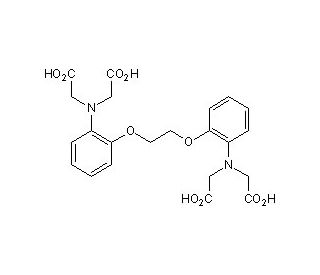

BAPTA, Free Acid (CAS 85233-19-8)
See product citations (10)
QUICK LINKS
BAPTA, Free Acid, scientifically known as 1,2-bis(2-aminophenoxy)ethane-N,N,N′,N′-tetraacetic acid, serves as a versatile chelating agent extensively employed in scientific research to sequester and eliminate metal ions from solution. This compound finds widespread applications in various research applications, due to its ability to investigate a broad range of biological processes. BAPTA, Free Acid has proven instrumental in deciphering drug mechanisms of action, exploring the biological activities of compounds, investigating the biochemical and physiological effects of substances, and studying compound pharmacodynamics. By binding and removing metal ions, BAPTA, Free Acid impacts the activity of enzymes, receptors, proteins, and even drugs. Notably, it exhibits binding affinity towards several metal ions, including calcium, magnesium, zinc, and iron. This metal ion sequestration by BAPTA, Free Acid exerts influence over various biological and biochemical processes. In particular, BAPTA′s, Free Acid high selectivity for calcium (105-fold greater affinity for Ca2+ than for Mg2+) positions it as useful for calcium signaling studies, signal transduction investigations, apoptotic cascade analysis, and neuroscience research. Notably, BAPTA, Free Acid, in its free acid form, lacks cell permeability, rendering it especially useful for manipulating extracellular calcium levels. While BAPTA, Free Acid bears resemblance to the widely known chelator EGTA (ethylene glycol bis(beta-aminoethyl ether)-N,N,N′,N′-tetraacetic acid), it boasts greater resistance to pH fluctuations and demonstrates superior efficiency in calcium uptake and release processes. Additional BAPTA chelators available:BAPTA tetrapotassium salt (sc-202076),BAPTA/AM (sc-202488),BAPTA-APM (sc-206966),BAPTA-TMFM (sc-212043),5,5i difluoro Bapta(AM) (sc-217247),5,5i difluoro Bapta(K+ Salt) (sc-217248) Bapta-FF (AM) (sc-217696),BAPTA, Tetrasodium Salt (sc-278716)
BAPTA, Free Acid (CAS 85233-19-8) References
- Regulation of intra-Golgi membrane transport by calcium. | Porat, A. and Elazar, Z. 2000. J Biol Chem. 275: 29233-7. PMID: 10871627
- Carbachol inhibits the L-type Ca2+ current augmented by 1,2-bis(2-aminophenoxy)ethane-N,N,N',N'-tetraacetic acid in guinea pig ventricular myocytes: calcium-sensitivity hypothesis for muscarinic inhibition. | Shen, JB. and Pappano, AJ. 2001. J Pharmacol Exp Ther. 298: 857-64. PMID: 11454952
- 1,2-bis(2-Aminophenoxy)ethane-N,N,N',N'-tetraacetic acid induces caspase-mediated apoptosis and reactive oxygen species-mediated necrosis in cultured cortical neurons. | Han, KS., et al. 2001. J Neurochem. 78: 230-9. PMID: 11461958
- Cytosolic Concentration of Ca2+ Regulates the Plasma Membrane H+-ATPase in Guard Cells of Fava Bean. | Kinoshita, T., et al. 1995. Plant Cell. 7: 1333-1342. PMID: 12242406
- Stratified organization of the nicotinic acetylcholine receptor channel. | Devillers-Thiéry, A., et al. 1992. Neuroreport. 3: 1001-4. PMID: 1282832
- 1,2-bis(2-aminophenoxy)ethane-N,N,N'N'-tetraacetic acid (BAPTA-AM) inhibits caffeine-induced apoptosis in human neuroblastoma cells. | Jang, MH., et al. 2004. Neurosci Lett. 358: 189-92. PMID: 15039113
- Multiple calcium channels and kinases mediate alpha7 nicotinic receptor neuroprotection in PC12 cells. | Ren, K., et al. 2005. J Neurochem. 94: 926-33. PMID: 15969741
- Inhibition of phospholipase C activity in Drosophila photoreceptors by 1,2-bis(2-aminophenoxy)ethane N,N,N',N'-tetraacetic acid (BAPTA) and di-bromo BAPTA. | Hardie, RC. 2005. Cell Calcium. 38: 547-56. PMID: 16140375
- Determination of 1,2-bis (2-aminophenoxy)ethane-N,N,N',N'-tetraacetic acid (BAPTA free acid) in rat plasma, urine and feces by liquid chromatography with UV and tandem mass spectrometric detection. | Feng, Z. and Wenying, L. 2010. J Chromatogr B Analyt Technol Biomed Life Sci. 878: 3052-8. PMID: 20965797
- Transmitter release at frog end-plate loaded with a Ca2+-chelator, BAPTA: hypertonicity and erythrosin B augment the release independently of internal Ca2+. | Tanabe, N. and Kijima, H. 1988. Neurosci Lett. 92: 52-7. PMID: 2847089
- Calcium-independent increase of transmitter release at frog end-plate by trinitrobenzene sulphonic acid. | Kijima, H. and Tanabe, N. 1988. J Physiol. 403: 135-49. PMID: 3150982
- Inositol 1, 4, 5-trisphosphate receptor is required for spindle assembly in Xenopus oocytes. | Li, R., et al. 2022. Mol Biol Cell. 33: br27. PMID: 36129775
- New calcium indicators and buffers with high selectivity against magnesium and protons: design, synthesis, and properties of prototype structures. | Tsien, RY. 1980. Biochemistry. 19: 2396-404. PMID: 6770893
- Properties of neuroprotective cell-permeant Ca2+ chelators: effects on [Ca2+]i and glutamate neurotoxicity in vitro. | Tymianski, M., et al. 1994. J Neurophysiol. 72: 1973-92. PMID: 7823112
- Chelation of intracellular Ca2+ inhibits murine keratinocyte differentiation in vitro. | Li, L., et al. 1995. J Cell Physiol. 163: 105-14. PMID: 7896886
Ordering Information
| Product Name | Catalog # | UNIT | Price | Qty | FAVORITES | |
BAPTA, Free Acid, 100 mg | sc-201508 | 100 mg | $68.00 | |||
BAPTA, Free Acid, 500 mg | sc-201508A | 500 mg | $267.00 |