
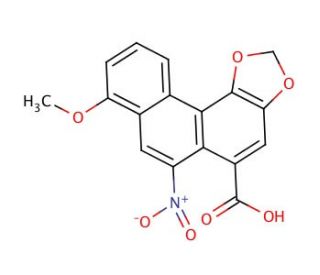

Aristolochic Acid (CAS 313-67-7)
Produktreferenzen ansehen (2)
Direktverknüpfungen
Aristolochiasäure wird in der Forschung eingesetzt, um ihre Wechselwirkung mit der DNA und die daraus resultierenden Auswirkungen auf zelluläre Mechanismen zu verstehen. In Studien wird häufig untersucht, wie Aristolochiasäure an die DNA bindet, was zu Mutationen führt, die die Forscher beobachten und analysieren können, insbesondere im Rahmen von genetischen Studien. Darüber hinaus wird Aristolochiasäure in der biochemischen Forschung verwendet, um ihre Auswirkungen auf die Aktivierung verschiedener Signalwege zu untersuchen, einschließlich derer, die mit zellulären Stressreaktionen zusammenhängen. In der Umwelttoxikologie dient Aristolochiasäure als Untersuchungsgegenstand für die Toxinexposition und ihre Auswirkungen auf Wildtiere und Ökosysteme. Darüber hinaus ist Aristolochiasäure aufgrund ihrer Rolle bei der Auslösung bestimmter zellulärer Reaktionen eine wertvolle Verbindung für Studien, die darauf abzielen, die molekularen Grundlagen der Zellzyklusregulierung und Apoptose zu verstehen.
Aristolochic Acid (CAS 313-67-7) Literaturhinweise
- Mykotoxische und Aristolochiasäure-Theorien zur Entwicklung der endemischen Nephropathie. | Peraica, M., et al. 2008. Arh Hig Rada Toksikol. 59: 59-65. PMID: 18407872
- Aristolochiasäure unterdrückt die DNA-Reparatur und löst oxidative DNA-Schäden in proximalen Tubuluszellen der menschlichen Niere aus. | Chen, YY., et al. 2010. Oncol Rep. 24: 141-53. PMID: 20514455
- Stoffwechsel von Aristolochiasäure I in der isolierten, durchbluteten Rattenniere. | Priestap, HA., et al. 2012. Chem Res Toxicol. 25: 130-9. PMID: 22118289
- Auswirkungen von Aristolochiasäure auf die Phospholipase A2-Aktivität und den Arachidonat-Stoffwechsel von menschlichen Neutrophilen. | Rosenthal, MD., et al. 1989. Biochim Biophys Acta. 1001: 1-8. PMID: 2536283
- Aristolochiasäure induziert den suizidalen Erythrozytentod. | Malik, A., et al. 2014. Kidney Blood Press Res. 39: 408-19. PMID: 25412628
- Aristolochiasäure I ist ein Substrat von BCRP, aber nicht von P-Glykoprotein oder MRP2. | Ma, L., et al. 2015. J Ethnopharmacol. 172: 430-5. PMID: 26183576
- Ödeminduzierende Aktivität der aus menschlicher Synovialflüssigkeit gereinigten Phospholipase A2 und Hemmung durch Aristolochiasäure. | Vishwanath, BS., et al. 1988. Inflammation. 12: 549-61. PMID: 3220517
- Aristolochiasäure löst bei Ratten durch oxidativen Stress mitochondriale Apoptose aus, was zu Leberschäden führt. | Wang, Y., et al. 2021. Toxicol Mech Methods. 31: 609-618. PMID: 34167444
- Die Erkennung von Aristolochiasäure I auf der Grundlage der Fluoreszenzlöschung von mit Rinderserumalbumin stabilisierten Goldnanoclustern. | Lu, Y., et al. 2022. Anal Methods. 14: 1963-1972. PMID: 35531633
- Aristolochiasäure I induziert eine Schädigung des proximalen Tubulus durch ROS/HMGB1/mt-DNA-vermittelte Aktivierung von TLRs. | Upadhyay, R. and Batuman, V. 2022. J Cell Mol Med. 26: 4277-4291. PMID: 35765703
- Curcumin lindert die Aristolochiasäure-Nephropathie auf der Grundlage des SIRT1/Nrf2/HO-1-Signalwegs. | Liu, Z., et al. 2022. Toxicology. 479: 153297. PMID: 36037877
- Charakterisierung von drei Ödem-induzierenden Phospholipase-A2-Enzymen aus Habu-Gift (Trimeresurus flavoviridis) und deren Interaktion mit dem Alkaloid Aristolochiasäure. | Vishwanath, BS., et al. 1987. Toxicon. 25: 501-15. PMID: 3617087
- Aristolochiasäure induziert eine Entzündungsreaktion mit Prostaglandin E2-Produktion und Apoptose in proximalen NRK-52E-Tubuluszellen. | Komatsu, M., et al. 2023. Toxicol Lett. 378: 39-50. PMID: 36863539
Bestellinformation
| Produkt | Katalog # | EINHEIT | Preis | ANZAHL | Favoriten | |
Aristolochic Acid, 25 mg | sc-200731 | 25 mg | $96.00 |