
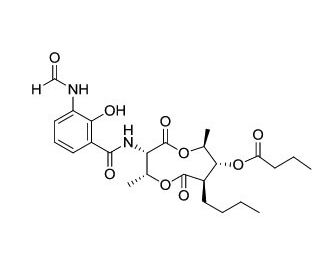

Antimycin A4 (CAS 27220-59-3)
ENLACES RÁPIDOS
La antimicina A4 es uno de los derivados de la familia de las antimicinas, un grupo de macrólidos producidos por la bacteria Streptomyces. Este compuesto destaca por su papel como potente inhibidor de la cadena de transporte de electrones mitocondrial, dirigiéndose específicamente al Complejo III (complejo citocromo bc1). Su mecanismo de acción implica la unión al sitio Q_i del Complejo III, lo que bloquea eficazmente la transferencia de electrones del ubiquinol al citocromo c, deteniendo así la producción de ATP e induciendo un rápido aumento de la producción de especies reactivas del oxígeno (ROS) dentro de la célula. Esta inhibición específica desempeña un papel crucial en la investigación centrada en la respiración celular y el metabolismo energético, lo que convierte a la antimicina A4 en una valiosa herramienta para los científicos que estudian las disfunciones mitocondriales y la regulación del estrés oxidativo. Además de su uso en estudios bioquímicos básicos, la Antimicina A4 se ha empleado en estudios ecológicos para evaluar el impacto de los inhibidores mitocondriales en los organismos acuáticos, contribuyendo así a las evaluaciones medioambientales de los sistemas acuáticos. Su capacidad para inducir la producción de ROS también la ha convertido en candidata para estudiar las respuestas celulares al estrés oxidativo, incluida la activación de las defensas antioxidantes y las vías de señalización relacionadas con la supervivencia celular y la apoptosis. A través de estas variadas aplicaciones, la antimicina A4 ha contribuido a avanzar en nuestra comprensión tanto de la biología medioambiental como de los procesos celulares fundamentales.
Antimycin A4 (CAS 27220-59-3) Referencias
- Antimicinas A10 aproximadamente A16, siete nuevos antibióticos antimicina producidos por Streptomyces spp. SPA-10191 y SPA-8893. | Hosotani, N., et al. 2005. J Antibiot (Tokyo). 58: 460-7. PMID: 16161485
- Los análisis químicos de bacterias streptomyces asociadas a avispas revelan un prolífico potencial para el descubrimiento de productos naturales. | Poulsen, M., et al. 2011. PLoS One. 6: e16763. PMID: 21364940
- Un único simbionte Streptomyces produce múltiples antifúngicos para mantener a la hormiga cultivadora de hongos Acromyrmex octospinosus. | Seipke, RF., et al. 2011. PLoS One. 6: e22028. PMID: 21857911
- Regulación y biosíntesis de las antimicinas. | Seipke, RF. and Hutchings, MI. 2013. Beilstein J Org Chem. 9: 2556-63. PMID: 24367419
- Regulación Coordinada de la Biosíntesis de Antimicina y Candicidina. | McLean, TC., et al. 2016. mSphere. 1: PMID: 27981234
- Un análisis filogenético y evolutivo de la biosíntesis de la antimicina. | Joynt, R. and Seipke, RF. 2018. Microbiology (Reading). 164: 28-39. PMID: 29111964
- Separación cromatográfica líquida de alto rendimiento de los subcomponentes de la antimicina A. | Abidi, SL. 1988. J Chromatogr. 447: 65-79. PMID: 3209667
- La regulación de la biosíntesis de antimicina está controlada por la proteasa ClpXP. | Bilyk, B., et al. 2020. mSphere. 5: PMID: 32269155
- El hongo simbiótico Leucoagaricus gongylophorus (Möller) Singer (Agaricales, Agaricaceae) como organismo objetivo para el control de las hormigas cortadoras de hojas. | Araújo, S., et al. 2022. Insects. 13: PMID: 35447801
- Antimicinas, inhibidores de la ATP-citrato liasa, de un Streptomyces sp. | Barrow, CJ., et al. 1997. J Antibiot (Tokyo). 50: 729-33. PMID: 9360616
Información sobre pedidos
| Nombre del producto | Número de catálogo | UNIDAD | Precio | CANTIDAD | Favoritos | |
Antimycin A4, .5 mg | sc-391461 | .5 mg | $260.00 |