
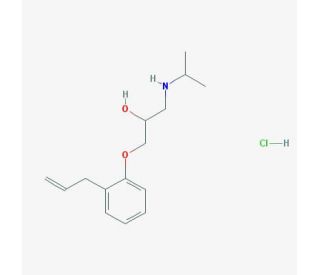

Alprenolol hydrochloride (CAS 13707-88-5)
Vedere citazioni di prodotto (2)
LINK RAPIDI
L'alprenololo cloridrato funge da antagonista principalmente dei β-adrenocettori, con una maggiore affinità per i sottotipi β2 rispetto a β1 e β3, e interagisce anche con i recettori 5-HT1A. Questo composto blocca efficacemente questi recettori, che sono responsabili di varie risposte fisiologiche. Inibendo i β1 e β2-adrenocettori, l'Alprenololo cloridrato modula gli effetti delle catecolamine endogene come l'adrenalina e la noradrenalina, che sono composti naturali che svolgono un ruolo nella risposta dell'organismo alla lotta o alla fuga. Questo blocco può alterare le vie di segnalazione cellulare, portando a risultati biochimici e fisiologici diversi. In ambito di ricerca, l'uso di Alprenololo cloridrato consente agli scienziati di studiare il ruolo di questi recettori in diversi sistemi e processi, favorendo la comprensione dei meccanismi e degli effetti sottostanti in vari contesti biologici. Inoltre, la sua interazione con i recettori 5-HT1A, coinvolti nella segnalazione della serotonina, offre ulteriori opportunità per esplorare la complessità dei sistemi neurotrasmettitoriali e le loro implicazioni nella modulazione dell'umore e delle funzioni cognitive.
Alprenolol hydrochloride (CAS 13707-88-5) Referenze
- Materiale polimerico ad impronta molecolare di dimensioni uniformi per (S)-propranololo. | Haginaka, J. and Sakai, Y. 2000. J Pharm Biomed Anal. 22: 899-907. PMID: 10857558
- Assorbimento gastrico, intestinale e colonico di una serie di beta-bloccanti nel ratto. | Vilà, JI., et al. 1992. Int J Clin Pharmacol Ther Toxicol. 30: 280-6. PMID: 1356102
- Identificazione delle isoforme P450 umane coinvolte nel metabolismo del farmaco antiallergico oxatomide e dei relativi parametri cinetici e costanti di inibizione. | Goto, A., et al. 2005. Biol Pharm Bull. 28: 328-34. PMID: 15684493
- Un'indagine sull'influenza della lipofilia del farmaco sui profili di assorbimento in vivo dalle microsfere sottocutanee e dai depositi in situ. | Deadman, CM., et al. 2007. J Control Release. 122: 79-85. PMID: 17638603
- Il beta-blocco acuto previene la desensibilizzazione dei recettori beta-adrenergici del miocardio e preserva la funzione ventricolare precoce dopo la morte cerebrale. | Pandalai, PK., et al. 2008. J Thorac Cardiovasc Surg. 135: 792-8. PMID: 18374758
- Strategie nello sviluppo di metodi per la quantificazione di impurezze enantiomeriche mediante CE. | El Deeb, S., et al. 2008. Electrophoresis. 29: 3552-62. PMID: 18803216
- Cromatografia elettrocinetica a tappeto per l'analisi simultanea di farmaci antidepressivi triciclici e β-bloccanti nelle acque reflue. | Aranas, AT., et al. 2011. Talanta. 85: 86-90. PMID: 21645674
- Gli stressors compromettono la memoria di riconoscimento degli odori attraverso un meccanismo noradrenergico dipendente dal bulbo olfattivo. | Manella, LC., et al. 2013. Front Integr Neurosci. 7: 97. PMID: 24391558
- Determinazione rapida e simultanea LC/MS/MS di 10 composti attivi nel siero umano per il monitoraggio terapeutico dei farmaci psichiatrici. | Sistik, P., et al. 2016. Biomed Chromatogr. 30: 217-24. PMID: 26094602
- Regolazione allosterica dell'attività dei recettori accoppiati a proteine G da parte dei fosfolipidi. | Dawaliby, R., et al. 2016. Nat Chem Biol. 12: 35-9. PMID: 26571351
- Caratterizzazione strutturale su larga scala di composti di droghe e simili mediante spettrometria di massa con mobilità ionica ad alta velocità. | Hines, KM., et al. 2017. Anal Chem. 89: 9023-9030. PMID: 28764324
- Ruolo dell'autofagia nel modello di trasfezione con peptidi penetranti nelle cellule. | Dowaidar, M., et al. 2017. Sci Rep. 7: 12635. PMID: 28974718
- La stimolazione del locus ceruleus modula il rapporto segnale/rumore nel bulbo olfattivo. | Manella, LC., et al. 2017. J Neurosci. 37: 11605-11615. PMID: 29066553
- Identificazione dell'alprenololo cloridrato come composto antiprione mediante la risonanza dei plasmonidi di superficie. | Miyazaki, Y., et al. 2019. Mol Neurobiol. 56: 367-377. PMID: 29704200
Informazioni ordini
| Nome del prodotto | Codice del prodotto | UNITÀ | Prezzo | Quantità | Preferiti | |
Alprenolol hydrochloride, 50 mg | sc-203503 | 50 mg | $117.00 | |||
Alprenolol hydrochloride, 100 mg | sc-203503A | 100 mg | $197.00 | |||
Alprenolol hydrochloride, 200 mg | sc-203503B | 200 mg | $306.00 | |||
Alprenolol hydrochloride, 500 mg | sc-203503C | 500 mg | $682.00 |