
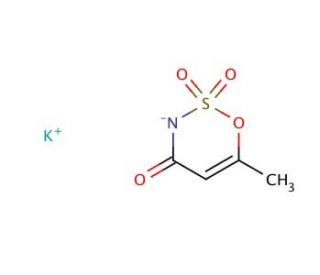

Acesulfame Potassium (CAS 55589-62-3)
QUICK LINKS
Acesulfame potassium, known as acesulfame K or Ace K, is a widely used artificial sweetener in the food industry since the late 1980s. This white, odorless, and water-soluble powder possesses an impressive sweetness that is 200 times stronger than sugar. Its popularity stems from its ability to provide a sweet taste to various food and beverage products, such as soft drinks, yogurt, ice cream, and chewing gum. Additionally, acesulfame potassium finds application in pharmaceuticals and personal care items. One of the key advantages of acesulfame potassium is its effectiveness as a low-calorie sweetener without an unpleasant aftertaste. Its high sweetness and low-calorie content make it a favored choice for those seeking to reduce sugar consumption while still enjoying sweet flavors. In the realm of scientific research, acesulfame potassium serves a wide range of purposes. Numerous studies have highlighted the diverse biochemical and physiological effects associated with acesulfame potassium. For instance, animal studies have shown its potential to enhance insulin sensitivity and lower blood glucose levels. In vitro experiments have demonstrated its ability to impede cancer cell growth and reduce inflammation.
Acesulfame Potassium (CAS 55589-62-3) References
- Bitterness of the non-nutritive sweetener acesulfame potassium varies with polymorphisms in TAS2R9 and TAS2R31. | Allen, AL., et al. 2013. Chem Senses. 38: 379-89. PMID: 23599216
- Long-term artificial sweetener acesulfame potassium treatment alters neurometabolic functions in C57BL/6J mice. | Cong, WN., et al. 2013. PLoS One. 8: e70257. PMID: 23950916
- A case study involving allergic reactions to sulfur-containing compounds including, sulfite, taurine, acesulfame potassium and sulfonamides. | Stohs, SJ. and Miller, MJ. 2014. Food Chem Toxicol. 63: 240-3. PMID: 24262485
- Quantification of acesulfame potassium in processed foods by quantitative 1H NMR. | Ohtsuki, T., et al. 2015. Talanta. 131: 712-8. PMID: 25281163
- The artificial sweetener acesulfame potassium affects the gut microbiome and body weight gain in CD-1 mice. | Bian, X., et al. 2017. PLoS One. 12: e0178426. PMID: 28594855
- Antiglycating potential of acesulfame potassium: an artificial sweetener. | Ali, A., et al. 2017. Appl Physiol Nutr Metab. 42: 1054-1063. PMID: 28618238
- Pharmacokinetics of Sucralose and Acesulfame-Potassium in Breast Milk Following Ingestion of Diet Soda. | Rother, KI., et al. 2018. J Pediatr Gastroenterol Nutr. 66: 466-470. PMID: 29077645
- Effect of AceK (acesulfame potassium) on brain function under dietary restriction in mice. | Ibi, D., et al. 2018. Physiol Behav. 188: 291-297. PMID: 29458115
- Acesulfame potassium: Its ecotoxicity measured through oxidative stress biomarkers in common carp (Cyprinus carpio). | Cruz-Rojas, C., et al. 2019. Sci Total Environ. 647: 772-784. PMID: 30096667
- Rapid removal of acesulfame potassium by acid-activated ferrate(VI) under mild alkaline conditions. | Ghosh, M., et al. 2019. Chemosphere. 230: 416-423. PMID: 31112864
- A Review of the Environmental Fate and Effects of Acesulfame-Potassium. | Belton, K., et al. 2020. Integr Environ Assess Manag. 16: 421-437. PMID: 32065497
- Lack of potential carcinogenicity for acesulfame potassium - Systematic evaluation and integration of mechanistic data into the totality of the evidence. | Chappell, GA., et al. 2020. Food Chem Toxicol. 141: 111375. PMID: 32360221
- Acesulfame potassium induces dysbiosis and intestinal injury with enhanced lymphocyte migration to intestinal mucosa. | Hanawa, Y., et al. 2021. J Gastroenterol Hepatol. 36: 3140-3148. PMID: 34368996
- Evaluation of DNA damage induced by acesulfame potassium: spectroscopic, molecular modeling simulations and toxicity studies. | Hadidi, S., et al. 2022. J Biomol Struct Dyn. 1-10. PMID: 35916031
Ordering Information
| Product Name | Catalog # | UNIT | Price | Qty | FAVORITES | |
Acesulfame Potassium, 25 g | sc-210736 | 25 g | $245.00 |