
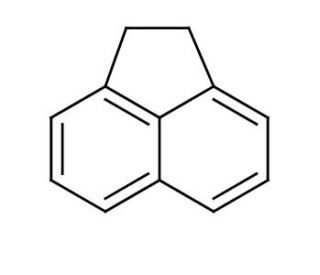

Acenaphthene (CAS 83-32-9)
QUICK LINKS
Acenaphthene is a polycyclic aromatic hydrocarbon that functions as a precursor in the synthesis of various organic compounds. It acts as a substrate in chemical reactions, participating in processes such as Friedel-Crafts acylation and cyclization reactions. Acenaphthene′s mechanism of action involves its ability to undergo electrophilic aromatic substitution, allowing it to react with various reagents to form new carbon-carbon or carbon-heteroatom bonds. Acenaphthene′s role in research and development lies in its capacity to serve as a building block for the creation of more complex molecules, contributing to the synthesis of agrochemicals and materials. At the molecular level, acenaphthene′s reactivity and structural properties make it useful for the construction of diverse organic compounds, enabling the exploration of new chemical entities and materials.
Acenaphthene (CAS 83-32-9) References
- Reactions of hydroxyl radicals and ozone with acenaphthene and acenaphthylene. | Reisen, F. and Arey, J. 2002. Environ Sci Technol. 36: 4302-11. PMID: 12387402
- Destruction of acenaphthene, fluorene, anthracene and pyrene by a dc gliding arc plasma reactor. | Yu, L., et al. 2010. J Hazard Mater. 180: 449-55. PMID: 20462691
- Characterization of the metabolic pathway involved in assimilation of acenaphthene in Acinetobacter sp. strain AGAT-W. | Ghosal, D., et al. 2013. Res Microbiol. 164: 155-63. PMID: 23178176
- Oxidation of Acenaphthene and Acenaphthylene by Human Cytochrome P450 Enzymes. | Shimada, T., et al. 2015. Chem Res Toxicol. 28: 268-78. PMID: 25642975
- Removal of acenaphthene from wastewater by Pseudomonas sp. in anaerobic conditions: the effects of extra and intracellular substances. | Qian, Y., et al. 2020. Environ Technol. 41: 1298-1306. PMID: 30284962
- Biodegradation of acenaphthene by Sphingobacterium sp. strain RTSB involving trans-3-carboxy-2-hydroxybenzylidenepyruvic acid as a metabolite. | Mallick, S. 2019. Chemosphere. 219: 748-755. PMID: 30557732
- Alternated biodegradation of naphthalene (NAP), acenaphthylene (ACY) and acenaphthene (ACE) in an aerobic granular sludge reactor (GSBR). | Ofman, P., et al. 2020. J Hazard Mater. 383: 121184. PMID: 31522063
- Nebulization dielectric barrier discharge ionization mass spectrometry: Rapid and sensitive analysis of acenaphthene. | He, J., et al. 2021. Talanta. 222: 121681. PMID: 33167287
- Exploring the interactions of acenaphthene with bovine serum albumin: Spectroscopic methods, molecular modeling and chemometric approaches. | Rostamnezhad, F. and Hossein Fatemi, M. 2021. Spectrochim Acta A Mol Biomol Spectrosc. 263: 120164. PMID: 34274633
- Acenaphthene adsorption onto ultrasonic assisted fatty acid mediated porous activated carbon-characterization, isotherm and kinetic studies. | Kumar, JA., et al. 2021. Chemosphere. 284: 131249. PMID: 34323792
- Removal of acenaphthene from water by Triton X-100-facilitated biochar-immobilized Pseudomonas aeruginosa. | Lu, L., et al. 2018. RSC Adv. 8: 23426-23432. PMID: 35540141
- First Hyperpolarizabilities of Intramolecular Charge-Transfer Architectures Based on Acenaphthene Derivatives in Gas, Solution, and Solid States. | Ye, JT., et al. 2022. J Phys Chem A. 126: 7432-7441. PMID: 36218337
- Colorimetric Detection of Acenaphthene and Naphthalene Using Functionalized Gold Nanoparticles. | Chuang, KJ., et al. 2023. Int J Mol Sci. 24: PMID: 37047607
- Toxicity of acenaphthene and isophorone to early life stages of fathead minnows. | Cairns, MA. and Nebeker, AV. 1982. Arch Environ Contam Toxicol. 11: 703-7. PMID: 7165389
- Use of 13C nuclear magnetic resonance to assess fossil fuel biodegradation: fate of [1-13C]acenaphthene in creosote polycyclic aromatic compound mixtures degraded by bacteria. | Selifonov, SA., et al. 1998. Appl Environ Microbiol. 64: 1447-53. PMID: 9546181
Ordering Information
| Product Name | Catalog # | UNIT | Price | Qty | FAVORITES | |
Acenaphthene, 1 g | sc-254933 | 1 g | $30.00 | |||
Acenaphthene, 5 g | sc-254933A | 5 g | $51.00 |