
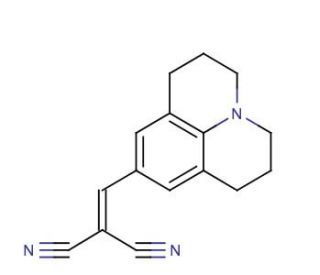

9-(2,2-Dicyanovinyl)julolidine 의 분자 구조, CAS 번호: 58293-56-4
9-(2,2-Dicyanovinyl)julolidine (CAS 58293-56-4)
대체 이름:
9-Julolidinylmethylenemalononitrile; DCVJ
적용:
9-(2,2-Dicyanovinyl)julolidine 는 단백질 등에 결합하는 데 사용되는 형광 프로브입니다.
CAS 등록번호:
58293-56-4
분자량:
249.31
분자식:
C16H15N3
연구용으로만 사용가능합니다. 진단이나 치료용으로 사용불가합니다.
* Refer to Certificate of Analysis for lot specific data.
빠른 링크
주문정보
설명
기술정보
안전정보
SDS 및 분석 증명서
9-(2,2-디시아노비닐)줄리딘은 흔히 DCVJ라고 부르는 합성 유기 화합물로, 다양한 과학 연구에 광범위하게 사용된다. 이처럼 반응성이 높고 다재다능한 분자는 광범위한 실험실 실험에 최적의 선택이다. 물, 알코올 및 에테르에 대한 용해성을 나타낸다. 9-(2,2-디시아노비닐)줄리딘은 과학 연구에 광범위하게 응용된다. 유기 합성의 귀중한 시약, 중합 반응의 촉매, 고분자 및 각종 물질 제조의 용매 역할을 한다. 9-(2,2-디시아노비닐)줄리딘은 친핵체 역할을 하는 전자 결핍 종과 공유 결합을 형성하는 능력을 가지고 있다. 이 반응은 알켄 또는 카르보닐기와 같은 전자 결핍 종을 친핵체가 공격하여 새로운 공유 결합이 형성되는 과정에서 발생한다. 이 특별한 반응은 다양한 합성 유기 반응의 기초 역할을 한다.
9-(2,2-Dicyanovinyl)julolidine (CAS 58293-56-4) 참고자료
- 분자 로터의 형광 이방성. | Levitt, JA., et al. 2011. Chemphyschem. 12: 662-72. PMID: 21328515
- 점도에 민감한 형광 분자 로터의 내재적 및 외재적 온도 의존성. | Howell, S., et al. 2012. J Fluoresc. 22: 457-65. PMID: 21947609
- 단백질 용액에서 눈에 보이지 않는 입자의 정량화, 크기 추정 및 특성화를 용이하게 하는 유세포 분석 기반 접근법. | Lubich, C., et al. 2015. Pharm Res. 32: 2863-76. PMID: 25788448
- 만지지 마세요! 흡착된 단백질의 마모는 교반 중 눈에 보이지 않는 입자 형성의 근본 원인입니다. | Sediq, AS., et al. 2016. J Pharm Sci. 105: 519-529. PMID: 26869415
- 삼환 시티딘 유사체에 의한 DNA 이중 형성의 형광 턴온 감지. | Burns, DD., et al. 2017. J Am Chem Soc. 139: 1372-1375. PMID: 28080035
- 단량체 및 섬유화된 α-시누클레인에 의한 시냅토뉴로좀 글루타메이트 방출의 자극. | Sarafian, TA., et al. 2017. J Neurosci Res. 95: 1871-1887. PMID: 28117497
- CCVJ의 유량 의존적 형광. | Schmidt, MJ., et al. 2017. J Biol Eng. 11: 24. PMID: 28785307
- 정전기 지질-단백질 상호작용은 지단백질 막 표면의 컬리 아밀로이드 접힘을 격리시킵니다. | Swasthi, HM. and Mukhopadhyay, S. 2017. J Biol Chem. 292: 19861-19872. PMID: 29021250
- 위상 분리 메커니즘의 동적 전환을 통해 NPM1-SURF6 스캐폴딩 네트워크의 구성 적응성을 구현합니다. | Ferrolino, MC., et al. 2018. Nat Commun. 9: 5064. PMID: 30498217
- 콜레스테롤 기반 화합물: 최근 합성 및 응용 분야의 발전. | Albuquerque, HMT., et al. 2018. Molecules. 24: PMID: 30597999
- 마이크로미터 이하 크기의 멤브레인 시스템에서 점도의 고처리량 측정을 위한 방법. | Chwastek, G., et al. 2020. Chembiochem. 21: 836-844. PMID: 31566864
- 형광 분자 로터를 이용한 비표지 폴리스티렌 나노입자의 검출 및 정량화. | Moraz, A. and Breider, F. 2021. Anal Chem. 93: 14976-14984. PMID: 34735123
- 저압 크기 배제 크로마토그래피에 의한 조직 내 폴리스티렌 나노플라스틱의 분리 및 정량화. | Gagné, F. 2022. J Xenobiot. 12: 109-121. PMID: 35645291
주문정보
| 제품명 | 카탈로그 번호 | 단위 | 가격 | 수량 | 관심품목 | |
9-(2,2-Dicyanovinyl)julolidine, 5 mg | sc-210694 | 5 mg | $52.00 |