
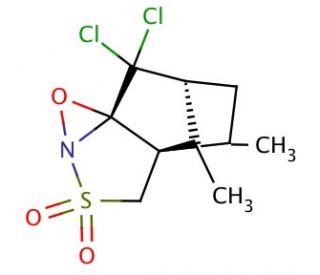

(−)-(8,8-Dichlorocamphorylsulfonyl)oxaziridine (CAS 139628-16-3)
ENLACES RÁPIDOS
(-)-(8,8-Dichlorocamphorylsulfonyl)oxaziridine, comúnmente conocido como DCCO, es un compuesto orgánico versátil y potente ampliamente utilizado en la síntesis orgánica y el desarrollo farmacéutico. Derivado del alcanfor natural, DCCO sirve como un valioso reactivo en entornos de laboratorio, ofreciendo una amplia gama de aplicaciones. DCCO encuentra utilidad en la investigación científica y médica, contribuyendo a la síntesis de nuevos medicamentos, la exploración de sistemas de administración de fármacos y la investigación de procesos bioquímicos y fisiológicos. Sus aplicaciones multifacéticas abarcan diversos ámbitos científicos. Es utilizado como reactivo para sintetizar moléculas complejas, incluyendo antibióticos y hormonas, y facilita el desarrollo de nuevos productos farmacéuticos. También ayuda a examinar procesos bioquímicos y fisiológicos, como la regulación de la expresión génica, el control de la proliferación celular y la inhibición de la síntesis de proteínas. Además, (-)-(8,8-Dichlorocamphorylsulfonyl)oxaziridine sirve como una herramienta valiosa para estudiar el impacto de los medicamentos en el sistema nervioso central. Aunque su mecanismo preciso de acción sigue sin entenderse completamente, se postula que DCCO actúa como un reactivo nucleofílico, interactuando con diversas moléculas como proteínas, carbohidratos y lípidos. Específicamente, su interacción con proteínas implica la formación de enlaces covalentes con cadenas laterales de aminoácidos, influyendo en la estructura y función de las proteínas, y posteriormente impactando los procesos celulares.
(−)-(8,8-Dichlorocamphorylsulfonyl)oxaziridine (CAS 139628-16-3) Referencias
- Monosulfoxidación selectiva de tetratiavalenos en TTF-sulfóxidos quirales. | Chas, M., et al. 2009. Chirality. 21: 818-25. PMID: 19205039
- Efecto de la agregación sobre la estereoquímica y el mecanismo de la oxidación asimétrica del enolato de litio del 3,3-dimetilbutanoato de metilo en estado sólido y en disolución | Yen Wei ∗R. Bakthavatchalam. 4 June 1993,. Tetrahedron Letters. Volume 34, Issue 23,: Pages 3715-3718.
- Estudios sintéticos sobre (1S)-1-(6,7-dimetoxi-2-naftil)-1-(1H-imidazol-4-il)-2-metilpropan-1-ol como inhibidor selectivo de la C17,20-liasa | Nobuyuki Matsunaga. 5 July 2004,. Tetrahedron: Asymmetry. Volume 15, Issue 13,: Pages 2021-2028.
Información sobre pedidos
| Nombre del producto | Número de catálogo | UNIDAD | Precio | CANTIDAD | Favoritos | |
(−)-(8,8-Dichlorocamphorylsulfonyl)oxaziridine, 5 g | sc-396622 | 5 g | $234.00 |