
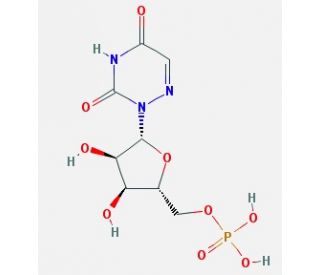

6-Azauridine-5′-monophosphate (CAS 2018-19-1)
See product citations (1)
QUICK LINKS
The human exosome complex, which includes EXOSC (exosome component) proteins, is a multi-protein complex with 3′-5′ exoribonuclease activity. This complex is crucial for the processing, degradation, and quality control of a wide variety of RNA species, including mRNA, rRNA, and tRNA. The EXOSC proteins within the complex serve as structural and functional constituents that facilitate the catalytic activity of the exosome. Signaling to and from the exosome complex often involves interactions with other cellular machinery, such as spliceosomes and ribosomes, to coordinate RNA metabolism. Overall, the EXOsc-regulated exosome complex serves as a central hub for RNA processing and degradation, ensuring the integrity and functionality of cellular RNA pools. EXOSC (exosome component) inhibitors comprise a specialized class of chemical compounds that target the exosome complex, a cellular structure involved in 3′-5′ exoribonuclease activities that participate in RNA processing and degradation. EXOSC inhibitors can operate through a range of mechanisms to affect these processes. Some may directly inhibit the enzymatic activities associated with the EXOSC components, while others might affect the assembly or stability of the exosome complex itself. Additionally, certain EXOSC inhibitors may act indirectly, targeting upstream or downstream elements that modulate the exosome′s actions, thereby affecting RNA metabolism.
6-Azauridine-5′-monophosphate (CAS 2018-19-1) References
- 6-azauracil-resistant variants of cultured plant cells lack uracil phosphoribosyltransferase activity. | Jones, GE. 1984. Plant Physiol. 75: 161-5. PMID: 16663563
- Design of inhibitors of orotidine monophosphate decarboxylase using bioisosteric replacement and determination of inhibition kinetics. | Poduch, E., et al. 2006. J Med Chem. 49: 4937-45. PMID: 16884305
- An examination of the relationship between active site loop size and thermodynamic activation parameters for orotidine 5'-monophosphate decarboxylase from mesophilic and thermophilic organisms. | Toth, K., et al. 2009. Biochemistry. 48: 8006-13. PMID: 19618917
- Crystallization of yeast orotidine 5'-monophosphate decarboxylase complexed with 1-(5'-phospho-beta-D-ribofuranosyl) barbituric acid. | Bell, JB., et al. 1991. Proteins. 9: 143-51. PMID: 2008434
- Purification and characterization of yeast orotidine 5'-monophosphate decarboxylase overexpressed from plasmid PGU2. | Bell, JB. and Jones, ME. 1991. J Biol Chem. 266: 12662-7. PMID: 2061334
- Proton transfer from C-6 of uridine 5'-monophosphate catalyzed by orotidine 5'-monophosphate decarboxylase: formation and stability of a vinyl carbanion intermediate and the effect of a 5-fluoro substituent. | Tsang, WY., et al. 2012. J Am Chem Soc. 134: 14580-94. PMID: 22812629
- Atomic resolution structure of the orotidine 5'-monophosphate decarboxylase product complex combined with surface plasmon resonance analysis: implications for the catalytic mechanism. | Fujihashi, M., et al. 2013. J Biol Chem. 288: 9011-6. PMID: 23395822
- Enzyme Architecture: Breaking Down the Catalytic Cage that Activates Orotidine 5'-Monophosphate Decarboxylase for Catalysis. | Reyes, AC., et al. 2018. J Am Chem Soc. 140: 17580-17590. PMID: 30475611
- Orotidine 5'-Monophosphate Decarboxylase: The Operation of Active Site Chains Within and Across Protein Subunits. | Brandão, TAS. and Richard, JP. 2020. Biochemistry. 59: 2032-2040. PMID: 32374983
- Study of the kinetic and physical properties of the orotidine-5'-monophosphate decarboxylase domain from mouse UMP synthase produced in Saccharomyces cerevisiae. | Langdon, SD. and Jones, ME. 1987. J Biol Chem. 262: 13359-65. PMID: 3308878
- The purification and preliminary characterization of UMP synthase from human placenta. | Livingstone, LR. and Jones, ME. 1987. J Biol Chem. 262: 15726-33. PMID: 3680222
- H NMR study of the conformation of the ribose phosphate moiety of 6-azauridine-5'-monophosphate--a nucleotide with an unusual conformation. | Hruska, FE., et al. 1973. FEBS Lett. 31: 153-5. PMID: 4709996
- In vivo synthesis of 6-azauridine 5'-triphosphate and incorporation of 6-azauridine into RNA of germinating wheat embryonic axes. | Rodaway, S. and Marcus, A. 1980. J Biol Chem. 255: 8402-4. PMID: 6157685
- Enhancement of intracellular 5-phosphoribosyl 1-pyrophosphate levels as a major factor in the 6-azauridine-induced stimulation of carbamoyl phosphate synthesis in mouse spleen slices. | Tatibana, M., et al. 1982. Eur J Biochem. 128: 631-6. PMID: 6185335
- Isolation and partial characterization of a 5'-nucleotidase specific for orotidine-5'-monophosphate. | El Kouni, MH. and Cha, S. 1982. Proc Natl Acad Sci U S A. 79: 1037-41. PMID: 6280163
Ordering Information
| Product Name | Catalog # | UNIT | Price | Qty | FAVORITES | |
6-Azauridine-5′-monophosphate, 10 mg | sc-291171B | 10 mg | $151.00 | |||
6-Azauridine-5′-monophosphate, 25 mg | sc-291171C | 25 mg | $286.00 | |||
6-Azauridine-5′-monophosphate, 50 mg | sc-291171 | 50 mg | $473.00 | |||
6-Azauridine-5′-monophosphate, 100 mg | sc-291171A | 100 mg | $837.00 | |||
6-Azauridine-5′-monophosphate, 250 mg | sc-291171D | 250 mg | $1753.00 |