
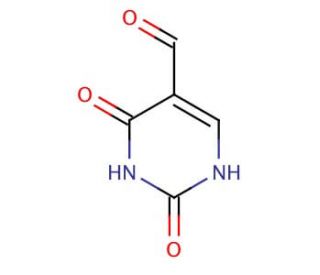

5-Formyluracil (CAS 1195-08-0)
QUICK LINKS
5-Formyluracil is a modified nucleobase, derived from uracil, that has been a subject of considerable scientific interest, particularly in the field of molecular biology and genetics. The primary structural difference between 5-formyluracil and uracil is the addition of a formyl group at the 5′ position of the uracil base. This alteration significantly changes the chemical and biological properties of the nucleobase, making it a valuable tool for various research applications. In the realm of biochemical research, 5-formyluracil is most notably used to study DNA and RNA modifications. One of the primary mechanisms of action of 5-formyluracil is its ability to mispair during DNA replication. Normally, uracil pairs with adenine; however, the formyl group at the 5′ position can cause 5-formyluracil to pair with guanine instead. This mispairing can lead to mutations, making 5-formyluracil a useful compound for studying mutagenesis and the fidelity of DNA replication. Additionally, 5-formyluracil has been used to investigate the processes of DNA repair and the recognition of damaged DNA. The presence of 5-formyluracil in DNA can be recognized by specific DNA repair enzymes, which initiate repair processes to remove the modified base and restore the DNA to its original state. This makes 5-formyluracil a potent tool for understanding how cells maintain genetic stability in the face of chemical modifications. Beyond its use in studying DNA dynamics, 5-formyluracil has also been utilized in epigenetic studies. The formyl modification can affect the way DNA interacts with regulatory proteins and how transcription is controlled, providing insights into the complex regulation of gene expression.
5-Formyluracil (CAS 1195-08-0) References
- Identification of repair enzymes for 5-formyluracil in DNA. Nth, Nei, and MutM proteins of Escherichia coli. | Zhang, QM., et al. 2000. J Biol Chem. 275: 35471-7. PMID: 10956660
- Synthesis of 5-substituted uracil derivatives. | Ressner, EC., et al. 1976. J Med Chem. 19: 194-6. PMID: 1107549
- 5-Formyluracil and its nucleoside derivatives confer toxicity and mutagenicity to mammalian cells by interfering with normal RNA and DNA metabolism. | Klungland, A., et al. 2001. Toxicol Lett. 119: 71-8. PMID: 11275423
- Highly Selective 5-Formyluracil Labeling and Genome-wide Mapping Using (2-Benzimidazolyl)Acetonitrile Probe. | Wang, Y., et al. 2018. iScience. 9: 423-432. PMID: 30466066
- Detection and Application of 5-Formylcytosine and 5-Formyluracil in DNA. | Wang, Y., et al. 2019. Acc Chem Res. 52: 1016-1024. PMID: 30666870
- Sequencing 5-Formyluracil in Genomic DNA at Single-Base Resolution. | Yang, W., et al. 2021. Anal Chem. 93: 15445-15451. PMID: 34775754
- The pH-Dependence of the Hydration of 5-Formylcytosine: an Experimental and Theoretical Study. | Zott, FL., et al. 2022. Chembiochem. 23: e202100651. PMID: 35084086
- Determination of 5-Formyluracil via Oxime-Based Nucleotide-Metal Coordination. | Zhang, K., et al. 2022. Chembiochem. 23: e202200355. PMID: 35849116
- Stoichiometry of the pyrimidine deoxyribonucleoside 2'-hydroxylase reaction and of the conversions of 5-hydroxymethyluracil to 5-formyluracil and of the latter to uracil-5-carboxylic acid. | Liu, CK., et al. 1972. Biochemistry. 11: 2172-6. PMID: 4260374
- A proposed mechanism for the mutagenicity of 5-formyluracil. | Privat, EJ. and Sowers, LC. 1996. Mutat Res. 354: 151-6. PMID: 8764944
Ordering Information
| Product Name | Catalog # | UNIT | Price | Qty | FAVORITES | |
5-Formyluracil, 1 g | sc-217193 | 1 g | $246.00 |