
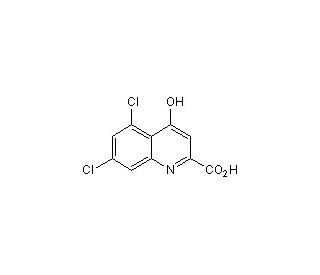

5,7-Dichlorokynurenic acid の分子構造、CAS番号: 131123-76-7
5,7-Dichlorokynurenic acid (CAS 131123-76-7)
アプリケーション:
5,7-Dichlorokynurenic acidは強力なNMDA受容体グリシン結合部位拮抗薬である
CAS 番号:
131123-76-7
分子量:
258.06
分子式:
C10H5Cl2NO3
試験・研究用以外には使用しないでください。 臨床及び体外診断には使用できません。
* Refer to Certificate of Analysis for lot specific data.
クイックリンク
注文情報
説明
技術サポート情報
安全情報
SDSと分析証明書
5,7-Dichlorokynurenic acid (CAS 131123-76-7) 参考文献
- NMDA/グリシン部位拮抗薬としての新規1,4-ジヒドロキノキサリン-2,3-ジオン類の合成とSAR。 | Zhou, ZL., et al. 2003. Bioorg Med Chem. 11: 1769-80. PMID: 12659763
- シュワン細胞は, NMDA受容体作動薬の放出と一致する興奮毒性を示す。 | Wu, SZ., et al. 2005. J Neurosci Res. 79: 638-43. PMID: 15672444
- キヌレン酸誘導体。興奮性アミノ酸拮抗薬の構造活性相関とN-メチル-D-アスパラギン酸受容体のグリシン部位における強力で選択的な拮抗薬の同定。 | Leeson, PD., et al. 1991. J Med Chem. 34: 1243-52. PMID: 1826744
- NR2拮抗薬のラット胸腔内投与は, 顔面ホルマリン誘発侵害行動を抑制する。 | Yang, GY., et al. 2010. J Orofac Pain. 24: 203-11. PMID: 20401359
- N-メチル-D-アスパラギン酸受容体関連グリシン結合部位における強力な拮抗薬である5,7-ジクロロキヌレン酸の活性。 | Baron, BM., et al. 1990. Mol Pharmacol. 38: 554-61. PMID: 2172769
- グリシン拮抗薬の中枢投与はモノアミン欠乏マウスの運動量を増加させる。 | Stauch Slusher, B., et al. 1994. J Neural Transm Gen Sect. 97: 175-85. PMID: 7873128
- N-メチル-D-アスパラギン酸受容体複合体を介して発現する核内転写因子の分子生物学的研究。 | Yoneda, Y. and Ogita, K. 1994. Nihon Shinkei Seishin Yakurigaku Zasshi. 14: 255-67. PMID: 7975930
- ラット脳におけるN-メチル-D-アスパラギン酸受容体イオノフォア複合体のグリシン認識ドメインにおける放射性標識アゴニストとアンタゴニストの結合プロファイルの違い。 | Yoneda, Y., et al. 1994. J Neurochem. 62: 102-12. PMID: 8263509
- ラット脳における5,7-[3H]ジクロロキヌレン酸によるN-メチル-D-アスパラギン酸受容体イオノフォア複合体上のグリシン認識ドメインの放射性標識の支持。 | Yoneda, Y., et al. 1993. J Neurochem. 60: 634-45. PMID: 8419541
- グリシンによるN-メチル-D-アスパラギン酸受容体の活性化:NR1サブユニットのM3-M4ループにおけるアスパラギン酸残基の役割。 | Williams, K., et al. 1996. Mol Pharmacol. 50: 701-8. PMID: 8863813
- マウス大脳皮質からのベラトリジンおよびK(+)刺激によるグルタミン酸放出に対するフェルバマートの効果。 | Srinivasan, J., et al. 1996. Eur J Pharmacol. 315: 285-8. PMID: 8982666
- ストリキニーネ非感受性グリシン受容体リガンドのラットにおけるジゾシルピンまたはフェンサイクリジンと生理食塩水の識別効果。 | Witkin, JM., et al. 1997. J Pharmacol Exp Ther. 280: 46-52. PMID: 8996180
- グリシン部位拮抗薬および部分作動薬は, 小脳顆粒細胞におけるN-メチル-D-アスパラギン酸受容体を介した[3H]アラキドン酸放出を阻害する。 | Viu, E., et al. 1998. J Pharmacol Exp Ther. 285: 527-32. PMID: 9580593
の阻害剤である:
GluR, GlyR α1 (GLRA1), NMDA, NP60.注文情報
| 製品名 | カタログ # | 単位 | 価格 | 数量 | お気に入り | |
5,7-Dichlorokynurenic acid, 10 mg | sc-200440 | 10 mg | $74.00 | |||
5,7-Dichlorokynurenic acid, 50 mg | sc-200440A | 50 mg | $409.00 |